Introduction: Why the Temptation Narrative Matters
The temptation of Christ is one of the most consequential and enduring narratives in Christian theology. It sits at the crossroads of temptation, obedience, messianic vocation, and the drama of spiritual warfare. The episodes traditionally recounted in the synoptic Gospels—Matthew, Mark, and Luke—depict Jesus of Nazareth confronting a tempter in the wilderness immediately after his baptism. This account is not merely a biographical anecdote; it is a theological manifesto about who Jesus is, what his mission entails, and how a human life can be lived in fidelity to God under pressure. The discipline of reflection on this topic yields insight for how believers understand temptation in their own lives, how they interpret the struggle between divine provision and human longing, and how they discern the proper use of power, trust, and worship.
In this long-form examination, we will survey the biblical text, explore historical and patristic interpretations, engage with different theological angles, and consider practical implications for faith, ethics, and spiritual formation. We will use variations and semantic breadth to keep the discussion precise yet expansive, including phrases such as temptation of Christ, Christ’s wilderness testing, tempting Jesus, the testing of the Lord, and Christ in the desert, all while maintaining a clear sense of the core question: how does the Son of God resist the adversary and affirm the Father’s will?
The Biblical Ground: Where the Temptation Narrative Appears
The temptation of Christ appears prominently in the three Gospels that tell the earliest canonical story of Jesus’ public life. Each Gospel presents a wilderness encounter after baptism but with nuanced emphasis:
- Matthew 4:1-11 narrates three temptations in a sequence that foregrounds the Saviour’s obedience as the true embodiment of righteousness, culminating in a rejection of worldly power in favor of worship of the Father alone.
- Luke 4:1-13 offers a parallel account with striking thematic emphasis on discipline, fasting, and a tested loyalty that echoes the people’s own journeys in the wilderness.
- Mark 1:12-13 provides a briefer note: Jesus is driven into the wilderness by the Spirit and is tempted by Satan for forty days, accompanied by wild beasts and by angels who minister to him. The Markan pace is sparse, but the underlying message remains the same: even the Son of God is sustained in a time of testing by divine provision.
While the temptation of Christ is a shared motif across these witnesses, scholars note that the gospel writers arrange and weigh details to illuminate particular theological horizons. The wilderness setting—often read as a place of purification, confrontation, and discernment—serves as a classroom in which Jesus demonstrates fidelity to the Father’s will and mastery over the tempter. The narrative is thus not merely about a historical event; it is a model for understanding how a deity who becomes human engages a hostile moral landscape without surrendering to temptation.
The Setting: Why the Wilderness and What It Symbolizes
The Desert as a Space of Purification and Trial
The wilderness or desert has long stood as a potent symbol in biblical and early Christian imagination. It is the place of bare living, where superficial accommodations fall away and one faces essential questions about dependence, identity, and vocation. In the temptation scene, the desert is not a passive backdrop but an active frame for testing. The stark landscape mirrors the interior exposure of Jesus to temptation and his refusal to abandon reliance on the Father.
Theologically, the desert is also a pedagogical setting: it is where a personal, divine mission takes shape under pressure, and where the Messiah’s obedience becomes visible in concrete choices. For readers and listeners who hear the tale in church, the desert invites contemplation of their own journey through times of scarcity, longing, and moral pressure, and it reframes hardship as a context in which a faithful life can be formed rather than merely endured.
The Tempter and the Shape of the Adversarial Challenge
Who Is the One Who Tempts?
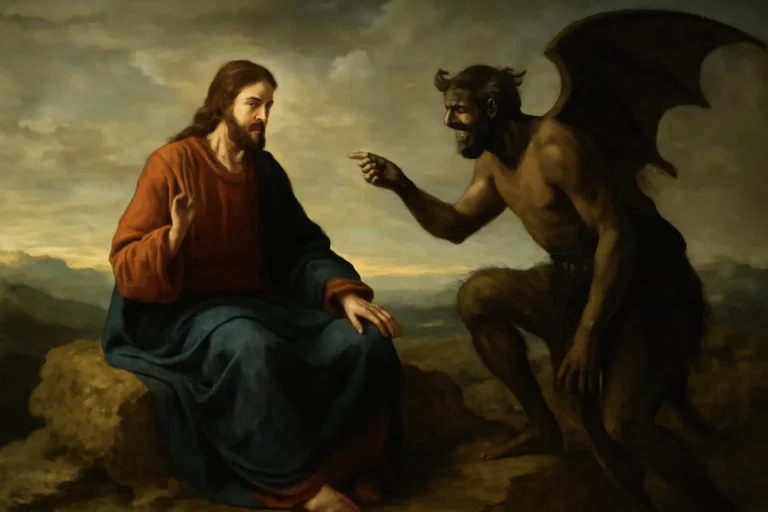
The figure most associated with these episodes is the tempter or Satan, a character deeply embedded in Jewish and early Christian conceptions of moral conflict. In the temptation of Christ, the adversary is not a mere allegory; he embodies legitimate questions about power, provision, and allegiance. The narrative does not present temptation as a casual suggestion; it portrays a deliberate, structured challenge to Jesus’ identity and vocation. The temptations probe three distinct arenas: physical need, divine protection, and political-messianic authority.
The Christian tradition has often debated the exact nature of this figure—whether the tempter operates as a personified evil, as a force of temptation within the human heart, or as a test permitted by God for a redemptive purpose. Across centuries, theologians have stressed that the temptations test not the sinlessness of Jesus but the authenticity of his obedience and his fidelity to the Father’s plan. The result is a Christ who is both fully human—feeling hunger, risk, and danger—and fully divine in his knowledge of Scripture and his decisive rejection of anything that would divert him from the mission of salvation.
The Three Temptations: A Theological Reading
First Temptation: Appetite, Hunger, and the Temptation to Shortcut the Messianic Timeline
The initial confrontation occurs when Jesus, after his prolonged fast, is urged to turn stones into bread. This temptation foregrounds a crisis about physical need and the proper use of divine power. On the surface, feeding a hungry person—especially the Son of God who has entered the world to bear human hunger—might seem righteous. But the narrative adds a crucial distinction: the Son’s mission is not to demonstrate power through spectacular miracles merely to satisfy personal hunger; it is to reveal obedience to the Father, even when appetite and urgency press in.
The response Jesus offers relies on a form of Scripture-centered discernment. He quotes or recites a principle about human life that transcends appetite: people do not live by bread alone, but by every word that comes from God. In this sense, the temptation is not merely about hunger but about the proper relationship between material provision and divine provision. The temptation to use power to convert stones into bread would reveal a self-reliant posture rather than a posture of trust in Fatherly care. The temptation of Christ in the wilderness thus reframes miracles as instruments of revelation—revelation of obedience, not self-assertion.
Second Temptation: Spectacle vs. Trust—Presumption and the Testing of God
The second trial moves from bread to platform and risk. The tempter invites Jesus to cast himself from the pinnacle of the temple, proposing that divine protection would be evident through miraculous rescue by angels. This temptation tests not just trust in God but the calculus of safety, visibility, and glory. It asks: should the Messiah prove God’s care by staging a public demonstration that would compel popular allegiance and awe?
Jesus answers by appealing to the integrity of the divine relationship: the Lord your God must be worshiped with reverence, and one should not put God to the test. This line acknowledges a dynamic that often surfaces in contemporary spiritual life: the urge to demand signs, to coerce outcomes, or to require divine risk on human terms. In the temptation of Christ, pressing for spectacular proof becomes a trap that could cheapen faith into sensationalism. The wilderness testing thus teaches a prudent discernment: fidelity does not require theatrical proof but steadfast worship and obedience even when the costs are unclear or high.
Third Temptation: Power and Worship—Rejecting a False Messiahship
The final and perhaps most consequential trial invites Jesus to accept political power and a grand proclamation by worshiping the tempter. The offer is the known currency of empire and control: all the kingdoms of the world and their splendor could be laid at his feet if he would bow to the adversary. Yet this is not a neutral exchange; it would redefine the Messianic mission in terms of worldly sovereignty rather than divine fidelity. The temptation to seize control by worshiping a rival power is a temptation to idolatry—an ensnaring shortcut that substitutes the Father’s plan with a negotiated settlement that looks successful by human standards but compromises the divine pattern of redemption.
Jesus resists this lure with a decisive affirmation: worship of the Lord your God alone, and serve him only. The refusal to accept the devil’s terms preserves the integrity of a unique, redemptive vocation. The Christology of this moment—where Jesus rejects political and religious shortcuts—helps readers understand the nature of true kingship: service, self-giving love, and faithfulness to the Father, not the manipulation of others or the accumulation of power for its own sake.
Theological Themes and Interpretive Angles
Christ’s Sinlessness and the Reality of Temptation
A central question in the reflection on the temptation of the Christ is how to understand the relation between temptation and sin. The Gospels depict Jesus as being tempted, yet not succumbing. This underscores a crucial theological claim: temptation is real and experiential for a divine-human figure, but sin is a choice that Jesus does not make. His victories in the wilderness disclose an inner obedience that he then extends to his ministry, passion, and resurrection. The narrative, therefore, has both a pastoral and a cosmic dimension: it teaches believers that temptation can be endured without yielding, and it confirms that obedience is not passive but actively engaged through faith, prayer, and the Word.
Christology and the Nature of the Messiah
The temptation of Christ in the wilderness also shapes how readers approach the identity of Jesus as the Messiah. If the people expected a triumphal king who would conquer Rome through impressive signs, the wilderness episodes reveal a different criterion: the Messiah’s authority and destiny are rooted in fidelity to the Father, not in diversions into power plays or public spectacle. This reframing invites contemplation of what it means for Jesus to be the rightful heir of promises by means of cruciform obedience, even when popular expectations would direct him toward a different path.
Scripture, Tradition, and the Power of Word
A striking feature of the temptations is Jesus’ reliance on Scripture as his primary defense. His responses demonstrate how the Word of God functions as both weapon and guide in spiritual warfare. The temptation narrative thus serves as a catechetical moment about the sufficiency of the revealed word for discerning truth, resisting deception, and anchoring human behavior in divine wisdom. The ethics of the three responses emphasize that sound moral action is not merely a matter of instinct or desire management but of aligning one’s will with God’s word, in dependence upon the Spirit.
Spiritual Warfare and Participation of the Spirit
The presence and role of the Holy Spirit are important in this account. Luke notes that Jesus was “full of the Holy Spirit” and led into the wilderness. This emphasis makes temptation not simply a personal test but a field where the Spirit equips the believer to resist evil. The interplay between divine enablement and human responsibility becomes a model for how communities understand spiritual warfare: it is not a lone battle, but a contest in which divine grace provides the faith, courage, and discernment needed to endure without capitulation.
Historical Echoes: Patristic and Medieval Readings
The temptation of Christ in the wilderness has a long reception history. Early church fathers such as Augustine, Origen, and John Chrysostom read this event as a paradigm for Christian life and ascetic discipline. Augustine’s reflections on the will and concupiscence illuminate how the temptations expose the misalignment between desire and divine law. Origen’s interpretive method often highlighted the spiritual senses of Scripture, inviting readers to view the temptations as allegories for the soul’s interior struggles. Chrysostom, with his pungent preaching, urged believers to imitate Christ’s steadfastness as a model of moral courage in the face of present-day temptations.
In medieval spirituality, the wilderness motif informed practices of fasting, prayer, and solitary contemplation. Monastic writers often used the Temptation in the Desert as a template for the ascetic journey: a life that is outwardly austere but inwardly oriented toward a loving, obedient relationship with God. The theological center remains consistent: true strength comes from allegiance to the Father and from the Word, rather than from self-will or worldly advantage.
The Temptation Narrative in Liturgical and Ecumenical Contexts
Across Christian traditions, the temptation of Christ has had significant liturgical and catechetical uses. In the Catholic and Orthodox churches, the episode is often revisited during Lent as a precursor to Jesus’ obedience unto the cross. In Protestant traditions, the narrative is frequently employed to teach about moral resolve, personal discipline, and the sufficiency of Scripture for moral discernment. The varied readings across centuries and communities reveal a shared conviction: the wilderness episode communicates a universal truth about the human condition—temptation is a real force—but it also communicates a universal hope: fidelity to God is possible, and it leads to a vocation of service, mercy, and justice.
Ethical and Practical Implications for Contemporary Believers
- Recognize that temptation is common, not exceptional—the narrative invites readers to view temptation as a normal aspect of life, not a sign of spiritual failure.
- See Scripture as a primary resource—as Jesus models, the Word of God provides clarity, orientation, and strength to resist coercive or manipulative temptations.
- Discern the proper use of power—the three temptations warn against misusing God-given gifts for personal ease, public spectacle, or idolatrous ends.
- Embrace dependence on divine provision—the fasting and wilderness setting foregrounds a theology of reliance on the Father rather than on self-sufficiency.
- Engage spiritual warfare responsibly—the temptation narrative offers a framework for recognizing spiritual forces at work while affirming the victory of Christ and the gifting of the Spirit to believers.
Variations in Language and Semantics: How We Talk About the Temptation
To enrich understanding and ensure semantic breadth, scholars and commentators use a spectrum of expressions. You will encounter:
- temptation of Christ and Christ’s temptation as interchangeable designations for the event in the wilderness.
- tempting Jesus and the tempting of Jesus to highlight the action of the adversary within the narrative frame.
- testing of the Lord and the wilderness testing to emphasize the question of divine tests and the boundary between providence and presumption.
- the desert encounter with Satan as a descriptive phrase that foregrounds the personal confrontation.
These terminological variations are not mere stylistic choices; they reflect different theological emphases: some highlight Jesus’ obedience in the face of real pressure, others emphasize the moral and spiritual dynamics of listening to God in moments of danger, and yet others point to the broader biblical pattern of testing that appears in the narrative arc of Israel as well as in Jesus’ own life.
Stories, Sermons, and Songs: The Cultural Afterlives of the Temptation
The temptation of Christ in the wilderness has influenced liturgy, music, art, and popular imagination in diverse ways. In liturgy, the season of Lent in many Christian traditions is a time of fasting, reflection, and repentance that resonates with the wilderness motif. In art and literature, the desert struggle has been used to explore questions of fidelity, power, and sacrifice. Sermons across the ages have drawn on the threefold structure of the temptations to illustrate how fidelity to God shows up in everyday life: when hunger presses, when risk tempts faith, and when power tempts domination. The enduring narrative thus continues to offer a vocabulary for moral discernment and spiritual formation.
Conclusion: The Temptation of Christ as a Template for Faithful Living
The temptation of Christ in the wilderness is not merely a historical episode; it remains a living matrix for Christian discipleship. By staging a confrontation with three distinct temptations—hunger, spectacular testing, and rulers of the world—the gospel writers present a compact curriculum of obedience. Jesus models a life oriented to the Father, sustained by the Spirit, and grounded in the Word. This is a template for faithful living in a world filled with competing claims, seductive shortcuts, and pressures to worship power rather than God.
For contemporary readers and worshippers, the temptation narrative invites a reflective practice: to acknowledge times of trial without surrendering to despair, to rely on Scripture as a compass, and to pursue a path of humble service rather than self-asserting triumph. In this sense, the temptation of Christ becomes a compassionate and challenging invitation: to join Jesus in the desert not merely as witnesses of conquest but as participants in the ongoing work of God—where obedience, mercy, and justice shape a world in need of redemption.
Final Reflections: Living in Light of the Wilderness Encounter
The wilderness episodes invite believers to cultivate practices that fortify resolve: regular reading of Scripture, prayerful reflection, and a disciplined life that honors God rather than succumbs to shortcuts. They remind communities that temptation is a shared human experience, but also that divine help is real and accessible through Christ, the anointed one, and through the Spirit who empowers faithful response. As a result, the story of the temptation of Christ remains both ancient and profoundly contemporary—an invitation to a robust, confident, ek-static faith that trusts God in the desert and in every season of life.