Introduction: The Fall of Man as a Cornerstone of Religious Thought
The narrative commonly titled the Fall of Man occupies a central place in
the religious landscape of the Abrahamic traditions. It is not merely a tale about disobedience in a distant garden; it is a foundational discourse about human nature, knowledge, freedom, responsibility, and the possibility of redemption. Across biblical literature and its later interpretive streams, the event is portrayed with dramatic clarity: a moment when the first human beings—often named Adam and Eve in the canonical text—encounter a boundary, transgress, and face consequences that reverberate through history and time. This article navigates the Fall of Man by presenting its scriptural contours, its linguistic varieties, its theological implications, and its enduring influence on faith, ethics, and culture.
Genesis Narratives: The Creation, the Command, and the Temptation
The Creation of the First Human Beings
In the Genesis account, the creation of the first human(s) unfolds as a layered process. The text describes God fashioning a being from the dust of the earth and imparting life through the breath of God. In the Hebrew tradition, this figure is referenced with the word adam, which functions both as a generic term meaning “man” and as a proper name. The idea that Adam is formed from Adamah, the soil or ground, carries a powerful symbol: humanity is inherently tied to the earth, yet endowed with a special vocation and consciousness. The companion being, named Eve in tradition, is described as “the suitable helper” who corresponds to the man. Together, they inhabit a paradisiacal space—often called the Garden of Eden—where innocence, trust, and unity appear as the default setting of human existence.
The Prohibition and the Tempter
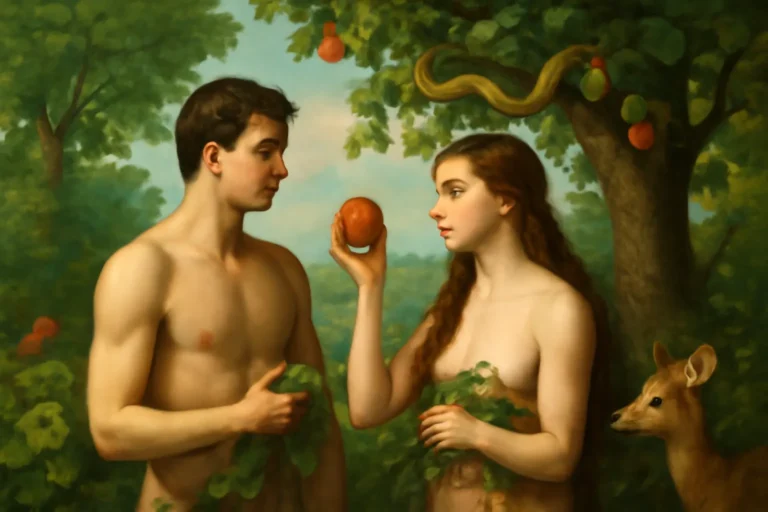
The pivotal moment arrives with a divine prohibition: a commandment regarding the tree of the knowledge of good and evil. The narrative identifies the challengers who disrupt this harmony: a cunning serpent, sometimes explicitly described as a crafty creature, who engages the woman in dialogue about autonomy, knowledge, and power. In this encounter, the figures commonly called Adam (the man) and Chava (the Hebrew name often translated as Eve) are confronted with a choice: to trust divine wisdom or to pursue a self-determined path. The text emphasizes that the temptation is not merely about desire for fruit; it concerns trust, obedience, and the orientation of the will.
The Transgression and Its Immediate Aftermath
The moment of disobedience is followed by a flood of consequences. The humans become aware of their vulnerability, experience shame, and confront a new sense of boundaries. The admonitions of the narrator reveal a chain of cause and effect: shame, guilt, and a newfound sense of mortality. In many readings, this is less a simple banishment and more a dramatic education—an invitation to explore the ethics of desire, responsibility, and faithfulness in a world now marked by loss and longing. The immediate consequences include an alteration of relationships: between the man and the woman, between humanity and the created order, and between the divine presence and the human life that now experiences estrangement.
Names, Origins, and the Semantics of Adam and Eve
Adam: The Ground, The Man, and The Prototypical Human
In the original language, the term adam bears multiple layers. It is a noun that designates man in a general sense, yet it can function as a proper name for the first human figure. The intimate connection to Adamah, the earth or soil, emphasizes the cosmological truth that humanity is drawn from the soil and sustained by it. This etymology has been a focal point for many theologians who read the Fall as a narrative about earthliness—the tension between earthly origin and divine vocation. Across linguistic traditions, variations of Adam recur: the Hebrew adam (אָדָם), the Aramaic, and later Greek and Latin forms that preserve the same core idea of humanness before, during, and after the fall.
Eve: Chava, Hawwah, Eva, and Their Names Across Traditions
The woman is named in ways that highlight her role and the meaning of life for the human community. In Hebrew, she is called Chava (often transliterated Hawwah), a term linked to the idea of life or living. In later Latin translations and in many Western Christian traditions, she becomes Eve, from the Hebrew Chava through linguistic pathways that render the name as the mother of all living. The name variation itself becomes a theological commentary: Chava’s designation foregrounds life, kinship, and the procreative vocation; Eve’s designation underscores lineage, memory, and the human story continuing through generations. Across traditions, the two figures may be described not only as historical protagonists but as archetypal persons who embody the human condition—the tug between innocence and knowledge, trust and incredulity, obedience and autonomy.
The Serpent as Tempter: Symbolism, sources, and Interpretive Layers
Language, Symbol, and the Agency of the Serpent
The serpent appears as a creature of cunning and rhetorical persuasion. Interpretations of the serpent vary across streams: some readings view it as a literal animal with a distinctive role within creation, others as a symbolic figure representing temptation, doubt, or the ambivalence of knowledge-seeking. The serpent’s temptation centers on reframing God’s command into a question about liberty and essence: is the divine boundary a constraint or a doorway to a more complete knowledge of good and evil? Through this dialogue, the first couple is drawn toward a decisive act, which then exposes a rift between divine sovereignty and human autonomy.
Theological Readings of Temptation
Across traditions, the serpent’s role invites a range of interpretations. In some expositions, temptation becomes a lens through which the problem of free will is examined: humans possess the capacity to choose, and that capacity carries weighty consequences. In others, the serpent is a symbol of civilizational desire—a story about how people navigate the promises of wisdom, power, and self-rule. Regardless of the specifics, the temptation narrative foregrounds a universal question: to what extent can a creature of earth discern divine intention, and what are the costs when that discernment falters?
Consequences of the Fall: Expulsion, Pain, and the Human Condition
Expulsion from the Garden and the Fragility of Paradise
Following disobedience, the narrative moves toward expulsion from the Garden of Eden, a moment that marks a dramatic shift in the human condition. The exile is not merely punitive; it is a pedagogical event. It teaches that life beyond the immediate sanctuary of the garden is infused with labor, risk, and mortality. Yet even in the wake of expulsion, the narrative harbors signs of mercy and ongoing divine providence: garments are provided, guards are placed at the entrance, and the promise—implicit or explicit—of future restoration looms in the background. The Fall’s consequences thus become a framework for understanding pain, toil, and the moral complexity of life in a fractured world.
Knowledge, Shame, and Human Wearsiness
A notable feature of the Fall is the emergence of self-awareness and moral discernment, accompanied by a dawning sense of vulnerability. The couple’s new knowledge brings a double-edged set of realizations: while they gain a broader understanding of good and evil, they also confront the responsibilities that accompany such knowledge. The experience of shame and guilt becomes part of the human repertoire, shaping how people interpret desire, restraint, and the possibility of repair.
The Fall in Theological and Philosophical Traditions
Patristic and Scholastic Perspectives
Early church fathers and later scholastics wrestled with the implications of the Fall for human nature and divine justice. Figures such as Augustine and his successors argued for the doctrine of original sin, a condition that transmits across generations and shapes tendencies toward disobedience. In Augustine’s account, the fall does not merely affect a single couple in a single epoch; it introduces a condition that all humans inherit, creating a need for grace and redemption. Other patristic voices, including certain Eastern fathers, offered nuanced readings that emphasize ancestral sin, the continuity of creation, and the role of free will within divine providence. These debates produced a rich tradition of reflection on how a perfect creation relates to a fallen one and how restoration becomes possible.
Jewish Interpretations and the Covenant Context
Within Jewish literature, perspectives on the Fall often stress ethical formation and covenantal life rather than a doctrine of inherited guilt. The narrative is read as a formative myth that clarifies human limitations, the seriousness of obedience, and the relationship between humanity and the divine order. The figure of Adam and the figure of Chava are examined in relation to their roles within the ancestral line, the meaning of the commandment, and the ongoing ethical responsibilities that emerge in post-Edenic history. The focus in this stream is frequently on repentance, mercy, and the restoration of harmony through faithfulness to God’s will.
Original Sin and the Doctrinal Landscape
The Augustinean Horizon
The hypothesis of original sin holds that the Fall creates a universal condition that affects all of humanity. For Augustine, this is not merely a historical account but a metaphysical claim about the nature of human inclination—the propensity toward disobedience to God and the need for divine grace to reconcile the broken relationship. This interpretive frame has profoundly influenced Western Christian theology, shaping doctrines around baptism, grace, and salvation. The Fall, in this view, is the reason the Son of God enters human history as a redeemer, offering atonement and the possibility of restoration to a state of grace.
Eastern, Western, and Protestant Variations
Within the broad Christian family, different traditions articulate the fall in varying terms. Some Eastern Orthodox writers emphasize ancestral consequences without the same emphasis on inherited guilt, focusing instead on the healing work of Christ as a restoration to the image of God, through theosis and participation in divine life. In Protestant traditions, the Fall becomes a catalyst for the theology of salvation by faith, grace, and the imputed righteousness of Christ. Catholic theology maintains a robust nuance—affirming original sin, while also holding that sanctifying grace is available through the sacraments and that Christ’s redeeming work offers a path to restoration.
Ethical and Existential Dimensions: Free Will, Knowledge, and Moral Responsibility
Freedom and Boundaries
A central issue raised by the Fall is the proper ordering of freedom. If human beings are created with the capacity to choose, then the issue becomes: what constraints are appropriate, and how does God’s command function within the moral economy of creation? The narrative suggests that freedom without trustworthy guidance leads to harm, while obedience guided by wisdom preserves life. The interplay between knowledge (the tree, the fruit, discernment) and obedience (to the divine will) provides a classic lens for discussing moral responsibility.
Knowledge as a Double-Edged Sword
The tree of knowledge symbolizes more than factual awareness; it represents the human longing to understand, to classify, to master, and to participate in a divine-like discernment. The Fall reframes knowledge as a matter of moral orientation—how one uses knowledge in relation to God, neighbor, and the world. This framing has provoked centuries of reflection on education, ethics, science, and spiritual life: when does knowledge become a form of power that distances truth from its source? When does it become light that clarifies how to love rightly, and when does it become a lure that corrupts the good?
Interpretive Varieties: Reading the Fall Across Communities
Judaism, Christianity, and Islam: Shared Roots and Distinct Emphases
Although the Fall story is most famously rooted in Genesis, its themes resonate across a broad religious spectrum. In Judaism, the narrative informs ethical living, covenantal faithfulness, and the ongoing possibility of repentance. In Islam, while the story is recounted with different theological emphases, it still highlights human accountability, divine mercy, and the drama of life as a test of fidelity to God’s commandments. Across these frameworks, the core motif remains: humans are invited to align themselves with divine wisdom, yet the path is complicated by desire, error, and the persistent invitation to return to trust.
Contemporary Theological Reflections
In modern theology, scholars explore the Fall not only as a historical event but as a narrative that shapes human identity, ethics, and hope. Some see it as a mythic framework for understanding the moral psychology of people living in a world marked by sin and grace. Others interpret the Fall as a dramatic drama that prefigures the adventure of salvation—an epic arc toward reconciliation, restoration, and the renewal of creation. Across these readings, the Fall remains a living touchstone for questions about human dignity, responsibility, and the possibility of redemption.
Theological and Spiritual Implications: Grace, Covenant, and Restoration
The Promise and the Path to Redemption
The Fall, while introducing distance between humanity and the Creator, also sets the stage for the gracious intervention of God. Across the biblical witness, a persistent thread points toward a future possibility of healing: covenants with Abraham, Moses, and David; prophetic expectations of return and renewal; and ultimately the Christian proclamation of the Incarnation, Passion, Resurrection, and the universality of grace. The narrative thus becomes a story of hope and restoration, not merely punishment. The drama invites believers to participate in God’s transforming work in the world, trusting that divine mercy can overcome the rupture created in the fall.
Symbolism and Archetypes: The Fall’s Rich Narrative Economy
Archetypes of Temptation, Knowledge, and Freedom
Beyond historical reading, the Fall offers archetypes that inform literary, artistic, and spiritual expression. Temptation appears as a universal motif in which the beloved becomes tempted by promises of autonomy, knowledge, and self-determination. Knowledge itself appears as an archetype of insight and moral discernment, a doorway that may lead to wisdom or to misdirected power. Freedom, in this frame, is the journey of learning to love rightly, to honor boundaries, and to seek truth in humble dependence on the divine source of life.
The Fall in Culture: Art, Literature, and Sacred Music
Artistic Reflections on Eden and Expulsion
The Fall has inspired a wide range of cultural productions—from Renaissance paintings to modern novels and cinematic retellings. In iconography and poetry, Eden is portrayed as a place of luminous harmony, while the expulsion evokes moral sensibilities about guilt, exile, and the longing for wholeness. These creative expressions illuminate how communities wrestle with the moral and spiritual questions that the Fall raises.
Music and Liturgy as Interpretive Doors
In liturgical and musical contexts, the Fall is often referenced as a reminder of human frailty and the need for grace. Hymns, psalms, and sacred music meditate on the themes of mercy, forgiveness, and the journey toward reconciliation. The interplay of music, scripture, and worship creates a reflective space where believers can contemplate the gravity of disobedience and the depth of divine patience.
Applications for Faith Communities: Pastoral, Ethical, and Doctrinal Implications
Pastoral Readings: Pastors, Teachers, and the Communal Life
For communities gathered in worship and study, the Fall narrative offers practical lessons. It invites believers to assess how they teach about temptation, how they approach accountability within the community, and how they extend grace to those who stumble. The story emphasizes the importance of humility, repentance, and mutual care, underscoring the idea that spiritual growth often begins with acknowledging one’s own limitations.
Ethical Practice in Light of the Fall
Ethical living in light of the Fall involves recognizing the moral stakes of daily choices: the use of power, the cultivation of wisdom, and the commitment to love others as oneself. It also involves a humility that recognizes dependence on divine guidance. Communities can translate these insights into ethical frameworks that honor human dignity, protect the vulnerable, and promote justice, mercy, and peace.
Conclusion: The Fall as a Framework for Meaningful Faith
The Fall of Man stands as a multi-dimensional hinge in religious thought. It asks enduring questions about the origin of human longing, the complexity of moral choice, and the possibility of return to a harmonious relationship with the Creator. By examining the variations of Adam and Eve across languages and traditions—Adam as the primordial man formed from Adamah, Chava as the living mother of all, the Garden of Eden as the theater of innocence and trust, and the fall as the introduction of knowledge and mortality—we gain a robust, nuanced understanding of what it means to be human in a world where grace meets fault. The Fall is not merely a condemnation of disobedience but a doorway into a narrative of mercy, redemption, and the ongoing invitation to live with discernment and hope.
Appendix: Quick Reference for Key Names and Concepts
- Adam — the first man; a name and a title meaning “man” and connected to the soil (Adamah).
- Ha-adam — Hebrew article form emphasizing “the man.”
- Chava / Hawwah — the wife of Adam; name linked to life or living.
- Eve — Latin/Western name derived from Chava, the mother of all living.
- Serpent — the tempter figure; symbolic and/or literal depending on interpretation.
- Garden of Eden — the paradisiacal setting of innocence, trust, and vocation.
- Original Sin — doctrinal concept in many Christian traditions describing inherited moral condition.
- Exile / expulsion — the removal from the Garden and the initiation of mortal life outside paradise.
In the end, the Fall of Man remains a profound narrative that persists across centuries because it speaks to the core questions that every culture faces: Who am I? What is my destination? How do I live with the knowledge I possess? What does it mean to need grace, and what does genuine freedom require? The biblical and theological exploration of Adam, Chava, and their descendants provides a communicative framework for reflecting on human vulnerability, divine fidelity, and the hope of reconciliation that transcends time and tradition.