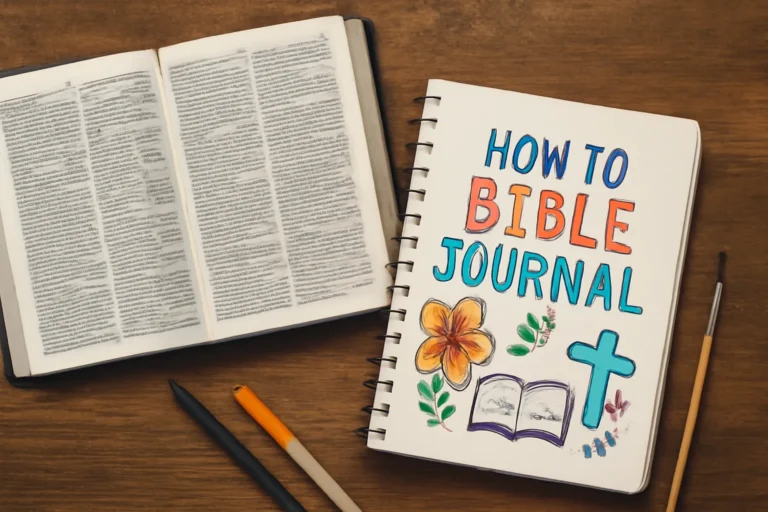
Bible journaling is more than a hobby or a trend. It is a deliberate, devotional practice that invites believers to engage with Scripture on multiple levels—reading, reflecting, responding, and applying. This step-by-step guide is designed to walk you through a practical approach to journal your Bible study, whether you are a beginner seeking a gentle entry point or a seasoned reader looking to deepen your habit. In the pages below, you will find thoughtful explanations, concrete steps, and resourceful ideas to help you make the practice consistently meaningful, anchored in faith and spiritual growth.
Bible journaling can be defined in several complementary ways. At its core, it is a practice of engaging with Scripture in a personal, creative, and reflective manner. Some people approach it as:
A discipline that combines reading, meditation, and artistic expression to store God’s Word in memory and heart.
A method of scripture interpretation that uses margins, notes, and visuals to process a passage’s meaning.
A way to cultivate spiritual formation by turning study into prayer, gratitude, confession, or commitment to action.
A repository of devotional insights and practical applications that can be revisited during future study or times of worship.
Different traditions and communities emphasize slightly different aspects. Some prefer a highly structured approach like the SOAP method (Scripture, Observation, Application, Prayer), while others favor a more creative or free-form style that blends writing with sketches, color, and doodles. No matter the method, the underlying aim is engaging with God’s Word in a way that strengthens faith, clarifies understanding, and motivates faithful living.
Why practice Bible journaling?
The reasons people choose to keep a Bible journal are as diverse as the community of believers who do it. Here are some of the most common motivations that many find compelling:
Memory and retention: Writing, highlighting, and illustrating help fix key verses and concepts in long-term memory.
Personalization of Scripture: Your margins become a space where your questions, life contexts, and spiritual milestones are recorded alongside the text.
Deeper understanding: The act of observing details, cross-referencing passages, and noting insights often leads to a richer interpretation.
Prayerful reflection: Journaling invites a prayerful posture—writing can become a form of talking to God, listening for His voice, and expressing gratitude or confession.
Creative worship: For many, art, color, and layout are valid forms of praise and devotion, not merely decoration.
Historical and spiritual continuity: Journals become a personal spiritual archive—stories of growth, answered prayers, and challenges overcome through faith.
When you approach journaled Bible study with humility and openness, you invite God to shape your thoughts, beliefs, and actions. This is less about preserving a perfect technique and more about cultivating a sustained, meaningful relationship with the biblical text.
Getting started: tools and setup
Before you begin your journey of Bible journaling, gather a few essentials. The goal is to create a space that is inviting, uncluttered, and conducive to contemplation. You do not need expensive supplies to begin—the best tools are those that you will actually use consistently with faithfulness and joy.
Choosing a journaling Bible or notebook
Journaling Bible: A Bible with wide margins or blank pages that you can write, sketch, and paste into. This is a popular option for many journalers because it keeps Scripture and notes together.
Notebook or sketchbook: A simple blank or ruled notebook can work well if you prefer to keep your notes separate from the text while still referencing the Bible.
Digital options: Some people use note-taking apps or digital journaling tools for convenience, searching, and organizing, though this slightly changes the tactile experience of a traditional journal.
Writing implements and art supplies
Fine-tip pens (for legible text in margins).
Pencils for initial outlines or light sketching (erasable).
Highlighters or colored pencils to emphasize themes, different voices, or cross-references.
Micron or archival pens to prevent bleed-through and ensure longevity of your notes.
Watercolor pencils or paints for subtle color accents in a treatment that remains readable.
Ruler, sticky notes, and a small scissors for neat margins and careful layout.
Appropriate environment and rhythm
Choose a quiet, comfortable space where you can focus without interruption.
Establish a regular journaling rhythm, whether daily, several times a week, or weekly.
Set a small, realistic goal for each session to avoid overwhelm and encourage consistency.
Decide on a routine that includes prayer or a moment of quiet before you begin, inviting the Holy Spirit to guide your reading and reflections.
Basic layout and structure
For a steady workflow, consider a simple layout that you can tweak over time:
Passage reference – noting the book, chapter, and verses.
Reading notes – key observations, questions, and initial impressions.
Verse highlights – verses you want to memorize or reflect on deeply.
Reflection and application – how the passage speaks to life, faith, and practice.
Prayer and response – a short prayer or a call to action based on the passage.
Begin with a posture of reverence and expectancy. Prepare your heart through prayer, worship, or a moment of stillness. Ask God to illuminate the text and to guide your reflections. Your inner posture matters as much as the technical process. Create a space that feels sacred and safe, a place where distractions are minimized and focus is possible. The practice of journaling is not merely a cognitive exercise; it is spiritual formation. When you enter with reverence, you lay a foundation for meaningful engagement with Scripture.
Step 2: Choose a passage and read attentively
Select a Bible passage that speaks to your current season. You might follow a reading plan, work through a book sequentially, or study a topic of interest. Begin by reading the text slowly, perhaps aloud, and observe what the passage says. Ask observing questions such as: Who is the author? Who is the audience? What is the historical or literary context? What stands out in the language or imagery? As you read, you may highlight phrases, underline recurring words, or jot brief notes in the margins. The aim is to let the Word speak and to prepare your heart for deeper engagement.
Step 3: Observe, interpret, and identify life applications
This step moves beyond surface meaning to a more intentional understanding. Consider three layers of engagement:
Observation: note what the passage communicates in its plain sense. What commands are given? What promises are offered?
Interpretation: reflect on what the text means in its original context and how that meaning translates to today. How does this Scripture reveal God’s character or His redemptive plan?
Application: determine practical implications for your faith, relationships, and daily life. What will you change, grow in, or pursue as a result of this study?
In your journal, you can record observations as bullet points, write short paragraphs, or draft a few questions you want to explore further. You may also note cross-references to other parts of the Bible that illuminate the passage. Throughout this step, you can use brief annotations and margin notes to capture insights in real time, without losing focus on the text itself.
Step 4: Respond with writing, art, or a combination
Here is where creative engagement becomes central. Your response can take several forms, depending on your personality, the passage, and your goals for journaling. Consider some of the following approaches:
Verse reflection: write a short paragraph reflecting on what a verse means for you and how it applies to your current situation.
Prayer journaling: compose a prayer in response to the Scripture, asking for God’s help to apply His Word in your life.
Verse mapping: break down a verse into components—who is speaking, to whom, what is the context, what is the main idea, and what are the implications.
Artistic expression: add doodles, margin sketches, watercolor washes, or decorative borders that symbolize the message, theme, or exact verse.
Color-coding: use colors to represent themes such as grace, mercy, faith, obedience, or promises.
Marginal prompts: write questions in the margins to guide future study or discussion with others.
Whatever form you choose, ensure that your response remains anchored in Scripture and directed toward spiritual growth. Avoid treating journaling as mere decoration; instead, let the page be a living conversation with God, a place where truth meets life in meaningful ways.
Step 5: Apply and integrate the Word into daily living
Application bridges the gap between knowledge and living. Ask yourself: What concrete steps should I take this week based on what I read? How can I demonstrate love, obedience, or courage in light of this passage? Some practical prompts include:
Identify an area of behavior or mindset you want to change and write a short plan to address it.
Commit to a specific action—such as extending grace to a difficult person, setting aside time for prayer, or serving someone in need—and record it in your journal.
Pray for measurable outcomes or spiritual growth that align with the text’s message.
As you apply the Word, you may also note testimonies of God’s faithfulness in your life, reinforcing the truth that Scripture is living and active. This is a central element of devotional journaling, where knowledge becomes praxis and hope is reinforced by experience.
Step 6: Review, reflect, and archive your insights
Over time, return to your journal entries to see how your understanding has deepened and how your life has changed as a result of your engagement with Scripture. A periodic review—monthly or quarterly—helps you:
Track patterns in your spiritual growth.
Identify recurring questions that may need further study.
Celebrate answered prayers and moments of transformation.
Preserve a personal spiritual archive for future generations or for your own reflection.
When archiving, you can maintain a simple system: date, passage, brief notes, and a reflection on how you’ve applied God’s Word. Some people create a separate section for highlights or a yearly summary that captures the big themes and memories of the journey.
Maintaining a productive Bible journaling practice requires intentional routines, but it should also remain flexible enough to accommodate life’s ebbs and flows. Here are practical tips that many find helpful:
Set a realistic cadence: even 10–15 minutes per session can yield meaningful progress if done consistently.
Use a trusted translation: choose a Bible version that feels readable and faithful to the text, so you can engage without friction.
Allow room for curiosity: your margins can host questions you may revisit later as you study more deeply.
Minimize self-criticism: remember that the goal is growth, not perfection. Be patient with yourself as you learn.
Incorporate accountability: pair with a fellow believer or a group to share insights and encourage one another in the practice of journaling the Bible.
Integrate with prayer: anchor each session in prayer so that your journaling remains a spiritual activity, not only an intellectual one.
Respect your uniqueness: your journaling style may be different from others—and that is okay. Bold creativity or quiet reflection both have value in spiritual formation.
Different styles and approaches
There is no single “right” way to practice scripture journaling. The practice can be tailored to your temperament, learning style, and spiritual goals. Here are several popular modes to explore, each with distinct strengths:
Verse mapping
Verse mapping is a structured approach that helps you trace themes and meanings within a verse or passage. A typical map includes:
The verse text, preferably in a larger or highlighted format.
The speaker and audience, to understand context.
Key phrases and their meanings, with cross-references to related verses.
Applications and prayer prompts based on each major point.
This method is especially helpful for sermons or theological study, as it clarifies how ideas connect and what the passage ultimately teaches about God, humanity, sin, and redemption.
SOAP method
The SOAP journaling framework is a simple, time-tested approach for personal Bible study. It stands for Scripture, Observation, Application, Prayer:
Scripture: write out the verses you are studying.
Observation: note insights about the text’s meaning and context.
Application: describe how the passage applies to your life.
Prayer: respond with a prayer that aligns with your reflections and requests for God’s guidance.
SOAP is especially popular because it creates a clear, repeatable rhythm that makes inductive journaling accessible and rewarding.
Inductive journaling
Bounded by the classic inductive Bible study method, this approach emphasizes careful observation, interpretation, and application. In journaling terms, you can structure your entries around:
Observation: what does the text say in its immediate context?
Interpretation: what does the text mean in its original setting?
Application: how should the truth prompt change or commitment in your life?
Inductive journaling favors precise questions and thoughtful cross-references, helping you arrive at conclusions that are faithful to Scripture and personally meaningful.
Creative journaling
Creative journaling blends art with Scripture. This can include decorative borders, color studies, hand-lettered verses, and symbolic imagery that communicates the message in a visual form. The goal is not to produce “fine art” but to allow creativity to aid memory, emotion, and devotion. For many, creativity makes the Word more accessible during times of spiritual dryness or fatigue.
Interleaved journaling
In interleaved journaling, you physically place notes, prayers, or insights in the margins or on pages adjacent to the Scripture you’re studying. It creates a dynamic conversation between the Word and your reflections, as if you were having an ongoing dialogue with God across the pages of your Bible.
Common questions about Bible journaling
Is Bible journaling compatible with traditional worship and church life?
Yes. Bible journaling can complement corporate worship, small groups, and personal devotion. It often enriches sermons by providing personal insights that can be shared in Bible study groups or during testimony times. Some congregations even encourage journaling as a way to engage with the Bible more deeply and to remember key truths discussed during services.
What if I’m not artistic?
artistry is not required. In scripture journaling, the most important element is your interaction with the Word. Simple notes, bolded text, and small symbols (like checkmarks, dashes, or underlines) can be deeply meaningful. Allow your journal to be a reflection of your personality and gifts—whether you lean toward words, color, or doodles.
How do I avoid clutter and maintain readability in margins?
Establish a simple, repeatable layout and use a consistent system. For example, you can reserve the left page for the Scripture and observations, and the right page for reflections, prayers, and application. Color-code themes and use brief, legible handwriting. If you are prone to over-decoration, set a limit for how much art you include per passage—enough to enhance understanding, not to overwhelm the text.
What are some starter passages for new Bible journalers?
Select passages that speak to foundational aspects of faith, such as the nature of God, the person and work of Christ, or guiding principles for living. Some beginner-friendy choices include:
Advanced considerations: theology, tradition, and interpretation
As you grow in Bible journaling, you may wish to explore deeper theological questions and engage with different interpretive traditions. Here are some avenues that serious journalers often pursue:
Contextual study: examination of historical, literary, and cultural contexts enhances accuracy and understanding.
Theological synthesis: integrating Scripture with doctrinal understandings about topics such as grace, salvation, sanctification, and God’s sovereignty.
Hermeneutics: the discipline of interpretation—recognizing how genre (poetry, narrative, prophecy, epistle) shapes meaning.
Cross-referencing: building a web of verses that illuminate key themes, promises, or commandments across the Bible.
When engaging with theology in your journaling, maintain a posture of humility, willing to revise ideas in light of Scripture and in conversation with trusted mentors or a faith community.
Sample journaling prompts to keep your practice fresh
What promise in this passage can I claim in faith today?
Which command or exhortation challenges me most, and how can I respond?
What does this say about God’s character, and how does that shape my worship?
Is there a sin, fear, or habit I need to surrender to God after reading this?
What prayer arises naturally from this text, and how will I pursue it?
Which life application will be my focus this week, and how will I measure progress?
Maintaining accountability and community in Bible journaling
While Bible journaling is a deeply personal practice, it can benefit greatly from community. Consider these ways to incorporate accountability and shared learning:
Join a small group or journaling circle where members share insights, questions, and passages they found meaningful.
Share a monthly or quarterly summary of your journaling journey, focusing on growth, challenges, and answered prayers.
Swap prompts or passages with a friend to gain new perspectives and maintain enthusiasm.
Offer to mentor a younger believer, modeling a healthy and reverent journaling practice that honors Scripture.
Ethical and spiritual considerations in Bible journaling
As with any spiritual discipline, there are ethical and theological boundaries worth observing to ensure the practice remains faithful to biblical teaching and a source of blessing rather than distraction. Consider these guiding principles:
Scripture first: let the Word of God be the primary source, not the journal’s aesthetics or popular trends.
Honor the text: avoid altering or distorting Scripture for the sake of a design or personal preference.
Purpose rooted in worship: journaling should lead you closer to God, not toward self-centered achievement or competition.
Discernment about content: be thoughtful about interpretations and claims you record, seeking confirmation through prayer, study, and dialogue with mature believers.
Stewardship of your materials: care for your Bible, journals, and art supplies as acts of stewardship that reflect a reverence for God’s Word.
Frequently asked questions
Do I need to be an artist to start Bible journaling?
No. The practice is not dependent on artistic skill. Your writing, color accents, and illustrations should support comprehension and devotion, not create a standard of appearance. The goal is to engage with Scripture in a meaningful, memorable way.
How long should a typical Bible journaling session last?
Even short sessions of 10–20 minutes can be deeply fruitful when consistent. The length can evolve with your season, but the key is to stay regular and focused rather than chasing lengthy sessions that become burdensome.
What if I miss a few days?
That’s normal. The practice is forgiving and flexible. Return with a renewed intention, reflect on what you missed, and begin again. The journal can serve as a witness to your faith journey, including times of interruption and restoration.
Use a simple system that helps you locate passages easily. You might organize by date, book, or theme. Consider keeping a digital index or a small notebook that lists the passages you studied, the insights gained, and the application you pursued.
Conclusion: the journey of Bible journaling
Bible journaling is not a one-time technique but a lifelong practice that invites you to sit with God’s Word and respond with your whole life. When you engage Scripture through observation, interpretation, reflection, and action, you move beyond passive reading toward transformative faith. The journaling process can become a means of spiritual nourishment, a way to record your journey with God, and a powerful tool for teaching future generations about the enduring truths of the Bible.
Whether you call it scripture journaling, bible study journaling, journaled Bible study, or devotional journaling, the underlying aim remains the same: to meet God in His Word, to let His truth shape your heart, and to live out His Word in love, obedience, and service. Your margins can become a sacred space where truth is encountered, questions are welcomed, and the Spirit’s work in your life is celebrated. Begin with a simple plan, stay anchored in Scripture, and let your journal be a faithful witness to the living God who speaks through the Bible today.