Introduction: The Bible’s Portrait of Hagar and Sarah
Within the Genesis narrative and its later interpretive streams, the figures of Hagar and Sarah (also encountered as Sarai in earlier texts) stand at a crossroads of kinship, promise, and human frailty. Their stories are not mere anecdotes about two women in an ancient household; they function as paradigms through which Jewish, Christian, and Muslim interpreters explore questions about faith, covenant, power, and ethics in the lived life of faith communities. This article surveys the biblical material, traces the rich web of theological meanings, and reflects on how these narratives have shaped worship, ethics, and spiritual reflection across centuries.
Names and Identity: From Sarai to Sarah, from Hagar to Hajar/Agar
Names in the Bible are rarely mere labels; they carry their own theological freight and historical resonance. Two sets of names are especially central to the Hagar–Sarah narrative:
- Sarai and Sarah: The wife of Abram (later Abraham) begins with the name Sarai, which the text says God changes to Sarah as part of a reaffirmation of the covenantal project. The transition from Sarai to Sarah marks a shift in her role—from merely Abram’s spouse to a participant in the divine promise to be a mother of nations.
- Hagar and its variants: The biblical reference is to Hagar, the Egyptian maidservant entrusted to Abram and Sarai as a surrogate mother. In several traditions and languages, her name appears in slightly different transliterations: Hajar (Arabic), Agar (Turkish and some older English renderings), or simply Hāgar in transliteration schemes. These variants appear in later commentaries and Qur’anic or Islamic tradition, where the figure becomes the mother of Ishmael alongside Ishaq/Isaac in broader sacred history.
The semantic field around these names helps readers notice two important dynamics: first, the process by which God’s promise interacts with human circumstances; second, the ways in which language and naming shape identity, status, and vocation. Sarah is introduced as the one through whom a lineage will emerge; Hagar is introduced as a vehicle of that promise, yet also as a figure who experiences social status, vulnerability, and agency within a patriarchal household. The interplay between these names—Sarai/Sarah and Hagar—serves as a narrative laboratory for exploring faith under pressure.
Genesis Narratives: The Early Encounters and the Household Covenant
Genesis 11–16: The Context of Promise and the Arrival of Hagar
The stories of Abram and Sarai unfold in a world of ancient Near Eastern kinship, nomadic movements, and divine encounter. When the text introduces Sarai and Abram (later re-named Sarah and Abraham), it sets a trajectory of covenantal expectation. The arrival of Hagar into this tale—an Egyptian maidservant acquired by their household—adds a new dynamic to the drama of childbearing and lineage.
- In Genesis 12–16, Abram is promised that his descendants will be as numerous as the stars. Yet the couple’s childbearing is delayed, and Sarai, who remains barren, seeks to fulfill the promise through a humanly arranged solution.
- The choice to give Hagar to Abram as a surrogate mother introduces a power imbalance that reverberates throughout the narrative. When Hagar conceives, tension arises in the household, illustrating how divine promise intersects with human strategy and social order.
The narrative does not solely present a procedural account of how a child will be born; it also foregrounds whether human plans subordinate themselves to divine initiative. In this sense, the figure of Hagar invites readers to consider questions of justice, agency, and care within the framework of a household that trusts in a larger divine purpose.
Genesis 16: The Birth of Ishmael and the Complex Feelings of the Household
The account in Genesis 16 centers on the immediate consequences of Sarai’s impatience with the promise. Hagar’s status shifts with pregnancy; conflict erupts between Sarai and Hagar, moving the narrative toward themes of domination, submission, and reconciliation—though reconciliation does not immediately resolve the deeper social tensions.
- The language of servant and mistress underscores a hierarchy that structures daily life. Hagar’s status is derived from her position in the household rather than from a freely chosen identity, raising ethical questions about autonomy and the dignity of the vulnerable.
- When Hagar bears a son—> Ishmael—the relationship within the family becomes relationally complicated. The excitement over a child sits alongside fear of losing status and control, presenting a paradox that readers continually revisit in later interpretations.
Genesis 17–21: The Name Change, the Covenant, and the Birth of Isaac
The turning point comes with God’s intervention in the life of Sarai and Abram. In Genesis 17, God renames Sarai as Sarah and Abram as Abraham, reaffirming the covenantal promise in a more expansive and inclusive format. The promise that a multitude of nations will proceed from them reframes the issue of infertility as a divine testing and a call to trust.
- The sign of the covenant in Abraham’s household becomes circumcision, a durable marker of belonging and obedience to the divine will. While this is primarily a male-centered ritual, its implications reverberate through the family’s structure and social ethos.
- The subsequent birth of Ishaq/Isaac (the son named by God) closes the immediate arc of the Hagar–Sarah tension as it was previously defined. However, the text does not erase the memory of Hagar’s presence; rather, it participates in a more nuanced portrait of divine faithfulness amidst human complexity.
The arc from Sarai to Sarah and from Hagar’s pregnancy to the birth of Isaac is a narrative of transformation that invites readers to reflect on how divine purposes unfold within imperfect human contexts. The change of names signals a new phase in the relationship between the divine promise and its human conveyance, a theme that resonates in later theological reflection.
Theological Themes in the Hagar–Sarah Episodes
Across the Genesis material and its later interpretations, several enduring themes emerge from the Hagar and Sarah episodes. The following facets demonstrate how the narratives function as a source for ethical reflection, communal formation, and spiritual growth.
- Covenant and promise: The divine promise to Abraham and Sarah remains central, even as human plans attempt to rush or reconfigure that promise. The text consistently asks whether human means align with God’s intention, and how faith is expressed in times of waiting.
- Faith and testing: The episodes place Sarah’s and Hagar’s experiences within a framework of testing—whether through infertility, social vulnerability, or the risk of disruption to the household’s equilibrium. Faith often appears not as flawless certainty but as persevering trust amid ambiguity.
- Hospitality and kinship: The household dynamics reveal how hospitality and kinship extend beyond bloodlines, calling readers to consider how communities welcome the vulnerable and integrate them into a shared divine vocation.
- Power and vulnerability: Hagar’s status as a slave in the family order foregrounds questions about authority, consent, and dignity. The text invites readers to examine power structures and their consequences for women in ancient societies—and, by extension, in contemporary communities that study these texts.
- Theological anthropology: The narratives explore what it means to be human in relation to a transcendent promise. They prompt reflection on how divine initiative intersects with human action, and how divine steadfastness sustains even when human plans falter.
Interpersonal Dynamics: Slavery, Power, and Reproductive Hope
Power, Social Roles, and Ethical Tension
The dynamics in the Abram–Sarai–Hagar household reveal a layered reality in which social roles—master/mistress and slave—shape possibilities and suffering. When Hagar conceives, Sarai’s sense of control is threatened, and friction arises. The text records a range of responses, some protective and some punitive, inviting readers to learn from the consequences and to pursue ethical pathways that honor human dignity.
Reproductive Hope and Its Perils
Reproductive hope is a central motive in ancient narratives, but it comes with peril when human strategies supersede trust in divine timing. The tension between desire for a legitimate heir and the reality of social order forces the characters to reckon with consequences that extend beyond personal longing into communal life.
- Reproductive desire is refracted through the moral imagination: how will the lineage be preserved? who will bear it? and at what social cost?
- The narrative does not glamorize coercive choices; rather, it presents the fallout of those choices and invites readers to seek a reading that emphasizes accountability, mercy, and reform.
New Testament Echoes: Galatians and the Two Covenants
In Christian interpretation, the Hagar–Sarah motif becomes a powerful typology for understanding two covenants and the dynamics of freedom and slavery in the life of faith communities. The Apostle Paul draws on this Genesis episode to illustrate deeper spiritual truths about the old covenant of law and the new covenant of grace.
- Galatians 4:21–31 presents the allegory: “the two women” are represented as two covenants—one associated with Hagar, the slave woman who bears Ishmael, and the other with Sarah, the free woman who bears Isaac. Paul sees this binary as a symbolic framework for contrasting bondage and freedom in the life of the church.
- Theological significance: The allegory serves to illustrate that faith communities are called to live in the freedom secured by the Spirit, not in a system of legal obligation that reduces people to property or mere instruments of lineage. The emphasis on freedom and promise reframes the narrative for a Christian-piformed ethics of inclusion, faith, and hope.
Across traditions, this typology has generated rich dialogue about how people relate to divine promises when human institutions—family, law, and social hierarchy—press for conformity. The Hagar–Sarah episodes invite believers to discern how to balance respect for tradition with a robust open table that welcomes those who are marginalized, all while honoring the integrity of the divine program.
Hagar and Sarah in Jewish, Christian, and Islamic Interpretations
The figures of Hagar and Sarah appear across a spectrum of religious communities, each with its own interpretive language and theological emphasis.
- Judaism: In Jewish interpretation, Sarah is celebrated as a matriarch whose faith is tested and refined through long waiting. Hagar’s presence is read with sensitivity to the social and moral complexities of her status, and Midrashic literature often expands on the human dimensions of the household, offering lessons about mercy, justice, and relational repair.
- Christianity: The Galatian interpretation frames the narrative as a crisis of freedom, law, and grace. The two women become a vivid metaphor for communities wrestling with inclusion, ethnic and social boundaries, and the character of God’s redemptive work in time. The language of promise fulfilled through faith becomes a central thread in Christian moral theology and ecclesial practice.
- Islam: In Islamic tradition, Hajar (the Arabic form) is revered as the mother of Ishmael and as a figure of steadfastness and trust in God. The narrative surrounding Hajar and Ishmael informs devotional practices like the rite of Sa’i during the Hajj, and it provides a spiritual memory of perseverance and divine care in the face of hardship. Sarah’s analogue exists in the broader biblical and Qur’anic context, where faith, patience, and obedience are emphasized as virtuous pathways to fulfill God’s plan.
Across these interpretations, the core biblical motifs persist: trust in the divine promise, the fragility and resilience of human agency, and the call to embody justice and compassion in community life.
Artistic and Liturgical Reflections
The Hagar–Sarah narratives have inspired a wide range of artistic expressions, from visual art to music and liturgical poetry. One finds in medieval, Renaissance, and modern art depictions that explore the emotional interiority and moral weight of the households in Genesis. In worship settings, these stories are often read with attention to their ethical dimensions—justice for the vulnerable, fidelity to God’s promise, and mercy in human relationships.
- Liturgical readings: Some traditions include readings from Genesis that emphasize the themes of waiting, promise, and covenant, inviting congregations to meditate on their own experiences of faith and hope.
- Poetic and musical settings: Hymns and psalms sometimes echo the motif of the “free woman” and the “slave woman” as symbols of spiritual states—freedom in Christ, delivery from bondage, and the renewal of trust in divine timing.
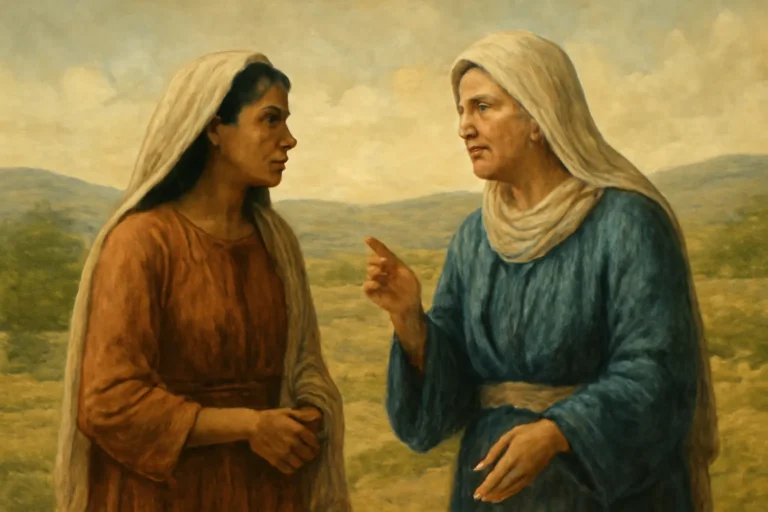
- Visual art: Painted cycles and iconographic programs have depicted the figures of Hagar and Sarah at moments of contest or consolation, prompting reflection on dignity, justice, and the mercy of God.
Ethical Reflections: Modern Relevance and Discernment
While these stories are ancient, their ethical questions remain current for faithful communities. Contemporary readers might reflect on:
- Agency and consent: How do communities protect the dignity and autonomy of those who occupy vulnerable positions within families or institutions?
- Justice and mercy: How should believers respond when social structures contribute to oppression? How can mercy be practiced in parallel with truth-telling and accountability?
- Waiting and trust: In times of prolonged uncertainty, how can communities cultivate patience and faith while pursuing practical care for those who bear the burden of infertility, loss, or marginalization?
- Inclusion and hospitality: What does it mean to extend welcome beyond social labels, to recognize the image of God in all persons, and to build communities that mirror divine generosity?
Variations in Translation and Exegesis: A Closer Look at Names and Terms
An attentive reader notices that the biblical text itself uses various forms and spellings that reflect linguistic and doctrinal histories. The following notes help illuminate how Hagar and Sarah appear in different contexts:
- Sarai vs. Sarah: The transition from Sarai to Sarah marks a change of vocation and destiny in the covenantal drama, signaling that God’s purposes are advancing beyond the initial call period.
- Hagar vs. Hajar / Agar: The same figure is rendered differently across languages and traditions. These variants reflect how communities locate her within their own lexicon while preserving her role in the Genesis narrative.
- Two covenants as a biblical-reading tool: Paul’s use of the Hagar–Sarah typology in Galatians provides a hermeneutical key for Christians to interpret the continuity or tension between law and grace in the church. For Jewish readers, the emphasis may shift toward covenantal faithfulness and the ethics of communal life; for Muslim readers, Hajar/Hagar is honored as a steadfast mother who complements Ishmael’s narrative in the Qur’anic corpus.
Conclusion: The Living Word for Faith Communities
The narratives of Hagar and Sarah are not static relics of a distant past; they are living texts that invite ongoing interpretation, moral reflection, and spiritual formation. They challenge communities to pursue faith with patience, to protect the vulnerable within social structures, and to trust in a divine promise that transcends immediate human strategy. The study of their stories—through reading, singing, preaching, and praxis—remains a dynamic force in biblical theology, church ethics, and interfaith dialogue.
Key Takeaways for Readers and Students
- Names and identity matter: Sarai/Sarah and Hagar/Hajar reveal how language encodes theology, promise, and social status.
- Divine promise requires patient trust: The arc from infertility to the birth of Isaac points to a God who fulfills long-awaited plans in ways that surpass human schedules.
- Justice and mercy belong to faithful living: The narratives exhort communities to protect the vulnerable and to pursue reconciliation even amidst tension and power imbalances.
- Two covenants, one human story: The Hagar–Sarah episodes illuminate the way the biblical canon interprets law, grace, freedom, and belonging—an interpretive thread that continues to shape contemporary faith and ethics.
Whether approached from a Jewish, Christian, or Islamic perspective—or from a historical-critical, literary, or devotional lens—the stories of Hagar and Sarah remain a powerful invitation to contemplate how faith, power, and promise intersect in the life of a community that seeks to live under God’s guidance.