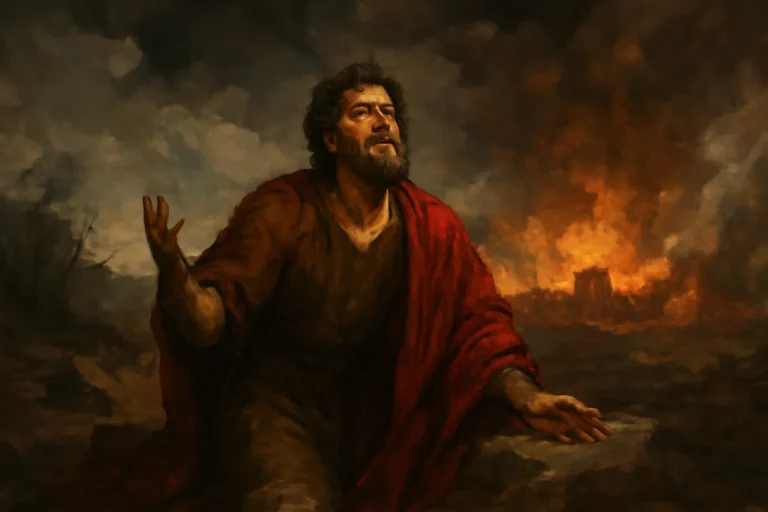
Introduction: The Portrait of a Faith-Filled Prophet
The biblical figure known as Habakkuk has long stood as a compelling example to people of faith who wrestle with the problem of pain, the pace of history, and the mystery of God’s governance. In many Christian and Jewish readings, the prophet Habakkuk’s journey moves beyond a simple historical account and becomes a powerful narrative about trust under pressure. He is not merely a distant Old Testament voice; he is often described as a man of incredible faith whose bold questions and steadfast hope illuminate what it means to live under God’s sovereignty when life is uncertain. This article offers a long, careful exploration of Habakkuk—often framed as the man of incredible faith—as a theological figure, a literary voice, and a pastoral exemplar for contemporary readers.
Throughout this exploration you will encounter variations on the way the phrase habakkuk man of incredible faith is understood and applied. You will also see how the biblical text itself uses a rhythm of wrestling, lament, divine response, and renewed trust that creates a durable framework for faith under pressure. The aim is not merely to catalog facts, but to illuminate how this figure can shape present-day discipleship, devotion, and interpretation.
Contextual Framework: Who Is Habakkuk and Why Should We Listen?
Historical Background
Habakkuk appears in the collection of the minor prophets, yet his voice sounds with the gravity of a major theological interlocutor. Most scholars place the book in the late 7th century BCE, during a period when the Judean reality faced the looming threat of imperial power and the turbulent upheavals of neighboring nations. The political and social climate—marked by injustice, moral confusion, and political instability—produced conditions in which a voice like Habakkuk’s could resonate with readers who sought to discern God’s plan amid chaos.
In this light, the man of incredible faith emerges not as someone who had all the answers, but as the one who asks the right questions at the right moments. He embodies a paradox familiar to many in faith communities: a person who remains in community with God while openly naming fears, doubts, and the weight of history. The prophet Habakkuk’s situation invites readers to compare their own timelines with God’s purposes, recognizing that divine timing often moves beyond human immediacy.
Literary Form and Structure
The book presents a distinctive dialogue: a bold declaration of complaint by the prophet, followed by a divine response, then a second circuit of vision and a concluding prayer. In many readings, this sequence dramatizes the journey of a deeply committed believer who refuses to reduce doubt to cynicism or faithfulness to mere sentiment. Rather, Habakkuk models a disciplined faith that persists through uncertainty.
First complaint and question: Why does injustice persist?
Divine answer: God will act, but not in the way or on the timetable Habakkuk expects.
Second vision (or woe): A clarifying revelation about the coming judgment on unrighteous powers.
Final prayer: A resounding statement of trust and praise, even when outward circumstances remain unsettled.
Habakkuk as a Paragon: The Man of Incredible Faith in Focus
Defining the Description: What It Means to Be a Faithful Prophet
If we speak of Habakkuk as the man of incredible faith, we are signaling a particular constellation of attributes. This is not merely an inner certainty; it is a public posture before God that shapes perception of reality, directs moral action, and informs how a community interprets history’s twists. Habakkuk’s faith is robust enough to sustain the mind grappling with paradox, and tender enough to nurture a heart capable of worship even in the face of incomprehension.
The designation habakkuk the faithful reformer appears in many sermons and devotional lineages as a way of naming the threshold where faith intersects with knowledge, and trust intersects with uncertainty. In that sense, Habakkuk’s path becomes a universal archetype: the one who does not abandon God when prophecy seems to threaten judgment, but who instead asks for clarity, accepts divine purposes, and moves forward with renewed fidelity.
The Dialogic Core: Prayer, Complaint, and Divine Declaration
The First Complaint: Confronting Injustice
The opening of Habakkuk is, in effect, a cry from a sincere heart seeking moral alignment with God. The prophet names the violence and inequity that pervade his world, and he refuses to reduce such reality to a simple claim that “everything will be okay.” This is a crucial feature of the figure often described as habakkuk man of incredible faith: his faith does not erase hard questions; it invites God to meet them with revelation.
In his first appeal, Habakkuk articulates a paradox: the faithful God who is just seems to tolerate—or even permit—conduct that contradicts the moral order he expects from the Creator. The form of his question is not hostile; it is a humble, honest search for alignment: How long, O Lord, will you not save? How long will injustice prevail? The answer to that question does not erase suffering, but it reframes it in light of divine sovereignty.
The Divine Response: A World Turned by God’s Sovereign Plan
God’s reply to the twofold complaint reveals a deeply theological posture: judgment and mercy, justice and salvation, all within the larger arc of redemption. It is here that Habakkuk, the faithful interlocutor, discovers that God’s methods include using even hostile powers as instruments in the broader drama of history. The phrase commonly cited in Christian readings—“the righteous shall live by faith”—enters the frame as a guiding principle that reorients Habakkuk’s understanding of what life under God’s rule requires.
The second chapter pivots on a vision that clarifies the problem of delay and power. The prophet is instructed to write the vision plainly so that a runner may read it and not misinterpret it. The theme of divine timing—where human patience and divine sovereignty meet—emerges as a central strand in the portrayal of Habakkuk, the man of unwavering trust.
Theological Themes Weaved Through Habakkuk’s Narrative
Faith and Lament
A hallmark of Habakkuk’s spiritual posture is the integration of lament with faith. He does not pretend that pain does not exist; instead he brings his pain into conversation with God and receives a response that reframes his experience. This convergence—lament joined to trust—helps readers see that habakkuk the faithful lamenter models a holistic approach to suffering within faith.
Divine Sovereignty and Human Responsibility
The book navigates the tension between God’s supreme authority and human agency. God’s use of the Babylonians as instruments of judgment raises the question of whether evildoers can serve God’s purposes. Habakkuk’s faith is not a naive denial of evil; it is a mature posture that trusts God’s purposes even when they transcend human perspective.
Justice, Injustice, and the Question of Timing
Habakkuk’s questions speak to a perennial concern: how can there be justice when suffering persists? The answer, as the text unfolds, does not offer a simple resolution but invites the faithful to trust that God’s justice is not immediate in every circumstance, yet remains sure. The man of incredible faith learns to “wait for the Lord” and to live by courageous obedience in the meantime.
The concluding chapter—Habakkuk’s anthem—transforms cognitive assent into liturgical praise. The text’s poetic cadence and theological depth offer a model of spiritual formation: knowledge becomes praise, doubt becomes worship, and fear yields to confident hope.
Key Passages and Their Echo Across the Bible
The phrase habakkuk man of incredible faith often resonates with other biblical motifs about faith and trust. A particularly important cross-reference is found in the New Testament, where the principle “the righteous shall live by faith” becomes a foundational line in Pauline theology. Habakkuk’s own moment of wrestling thereby germinates a grid for reading the gospel’s message of grace, faith, and salvation. In this way, the figure we are exploring—often described as the faithful prophet Habakkuk—becomes a bridge between prophetic literature and the later Christian proclamation of justification by faith.
Habakkuk’s Legacy in Jewish and Christian Traditions
In Jewish Thought
In Judaism, Habakkuk is valued for his fearless questioning and for the way his dialogue with God models a righteous relationship that embraces honesty before the divine. The tradition often highlights the humility with which Habakkuk receives God’s answer, and the way his faith remains intact even when historical circumstances seem to contradict human expectations. The man of incredible faith in this context is less about triumphant certainty and more about faithful fidelity under pressure.
In Christian Interpretation
Christian readings of Habakkuk frequently emphasize the example of perseverance and trust that he embodies. The apostolic writers, drawing on Habakkuk’s insistence that faith stands under suffering, apply a broader theological claim: faith in Christ is trust even when human experience does not align with immediate outcomes. The archetype of habakkuk the steadfast believer thus becomes a template for Christian patience, hope, and worship under trial.
Interfaith Reflections: A Shared Language of Lament and Hope
While the two faith traditions diverge on some points of doctrine, there is a shared recognition of the value of honest lament, urgent petition, and steadfast hope. The figure of Habakkuk—whether described as a man of incredible faith or simply as a faithful witness—offers a shared vocabulary for discussing hardship, divine justice, and the mystery of God’s governance in the world.
Practical Implications: Living as a Faithful Witness Today
Disciplines for the Faith-Filled Life
For readers who want to imitate Habakkuk’s spiritual posture in daily life, several disciplines emerge as especially meaningful:
Honest prayer that names one’s fears without fear of naming them.
Lament and petition that hold space for grief while inviting God’s response.
Patience in discernment as a form of active hope, rather than passive resignation.
Reading the signs of the times with humility before God, asking how to respond justly in one’s own context.
Faithful obedience when outcomes are uncertain, choosing to trust God’s character even when outcomes seem delayed or unclear.
Practice Scenarios: Applying Habakkuk’s Model
Consider these practical scenarios in which the Habakkuk-inspired approach to faith can be transformative:
When institutional dysfunction is visible in a community or church, the faithful observer speaks truth with humility, asking for reform without cynicism.
In times of national crisis, a man of incredible faith engages in lament that moves toward constructive action—advocacy, mercy, and justice-ordered service.
In personal life, when suffering or disappointment dominates, the faithful turn to prayer that acknowledges pain and seeks God’s perspective rather than a quick end to the distress.
Vision One: A Justice That Transcends Immediate Experience
The first vision in Habakkuk elevates a higher justice beyond what humans can measure by observable outcomes. The prophet’s lament becomes a doorway through which a more expansive divine plan begins to unfold. In this sense, Habakkuk’s life becomes an invitation to trust God’s overarching purposes even when earthly signs appear troubling.
Vision Two: A Hope Grounded in God’s Sovereignty
The second vision clarifies that divine sovereignty does not discard human suffering but recasts it in light of ultimate redemption. The text emphasizes that “the righteous shall live by faith” is not merely a private sentiment but a public stance of resilience and trust. The habakkuk faithful figure thus models how to live—step by step—while awaiting God’s redemptive work.
Key Theological Themes Revisited: The Faithful Prophet as a Theological Resource
The enduring significance of Habakkuk for theologians and lay readers alike stems from how his narrative engages central questions with depth and humility. The man of incredible faith demonstrates that faith is not a static possession but a dynamic relationship with God that grows through encounter, doubt, revelation, and worship.
Literary Accomplishments: The Book’s Poetic and Theological Craft
The Habakkuk text is known for its evocative imagery, crisp prophetic lines, and memorable refrains. It uses poetry to convey the weighty convictions of a person who loves God but is not afraid to interrogate God. The literary craft undergirding Habakkuk’s faith provides a resource not only for theology but for spiritual formation—a way to train the heart to respond to mystery with devotion, not ambivalence.
Connecting Past and Present: How Habakkuk Inspires Modern Faith Communities
As a Model for Faithful Inquiry
One of the most practical gifts from Habakkuk’s example is the legitimacy given to asking questions within the context of faith. The habakkuk man of incredible faith is portrayed not as one who outgrows doubt, but as one who learns to bring doubts to God in a disciplined, reverent fashion and then emerges with a strengthened trust.
As a Blueprint for Worship Under Pressure
The concluding prayer transforms despair into worship and expresses confidence in God’s saving deeds. This arc—lament to praise—offers a pattern for communities that must navigate pain and injustice without surrendering to despair.
Conclusion: Habakkuk as a Living Voice for Faith Today
In the biblical canon, Habakkuk stands out as a durable witness to a form of faith that is both honest and hopeful. The figure who is widely described in various traditions as the man of incredible faith invites readers to a posture of courageous inquiry, patient trust, and worshipful response. His story is not merely a historical curiosity; it is a theological instrument that helps clarifying questions about God’s justice, the meaning of suffering, and the ways in which a faithful life can endure with integrity and joy.
For readers seeking specific takeaways, the man of incredible faith Habakkuk offers a practical, theologically rich model for engaging with the real difficulties of life while remaining rooted in God’s promised faithfulness. Whether approached as a prophetic tale, a theological argument, or a devotional journey, Habakkuk’s voice remains compelling: a steadfast invitation to trust God, even when the present moment seems uncertain. In this sense, Habakkuk—often imagined as Habakkuk the faithful witness—continues to speak across time about what it means to live by faith in a world that defies easy explanation.