The Talking Donkey: A Sacred Encounter Across Ages
The story of Balaam and the miraculous intervention involving a humble donkey is one of the most enduring narratives in biblical literature. It presents a narrative arc that moves from a foreign prophet-for-hire’s ambitions into a profound encounter with the living God. The strange image of a beast of burden that speaks, guiding a stubborn man away from peril, has resonated across generations and traditions. In this long-form exploration, we will walk through the arc of Balaam’s journey, the symbolic power of the talking donkey, and the theological and ethical lessons embedded within the text. This article seeks to illuminate not only what happened in the ancient near east setting but also how readers today might draw practical wisdom for reverence, discernment, and faithful leadership.
The talking donkey serves as a dramatic device that reveals a larger biblical pattern: God often communicates through surprising vessels, overturning human expectations about who can speak truth to power. While the donkey’s speech is a unique miracle, the broader message is about recognizing divine sovereignty, discerning true prophecy, and testing one’s motives when confronted with opportunity, wealth, or political power. This lesson is not confined to Sunday school; it engages scholars, preachers, students, and thoughtful readers who seek to understand how God’s will intersects with human ambition.
The Setting: Balak, Moab, and the Prophetic Ambition
To understand Balaam’s journey, we must first situate it in its political and religious milieu. Balak, the king of Moab, faced the encroaching threat of the people of Israel as they moved toward the promised land. In this context, Balak sought a prophetic word that would curse Israel, hoping to neutralize the threat. Into this scenario enters Balaam, a non-Israelite prophet or seer whose ancestral heritage was linked to Beor. He is described in the biblical text as someone who has insight and influence, yet who must submit his words to the God who speaks to him.
It is essential to recognize the tensions at play: political calculation, religious authority, and the moral hazard of profit-driven prophecy. Balaam’s encounters with Balak’s messengers, his negotiations over tribute or reward, and his growing recognition that divine instruction overrides human desire make this a multifaceted study. The narrative challenges readers to ask: When a prophet’s lips are touched by God, what happens to pride, greed, and personal advantage? And what does it mean for a powerful ruler to seek to bend prophecy toward political ends?
The Journey Begins: An Acknowledgment of Divine Oversight
The journey of Balaam begins with a provocative invitation: come, and perhaps you can curse Israel, Balak believes, and thereby shake God’s favor. But the biblical text quickly overturns human expectations.[A]s Balaam travels, the divine encounter interrupts him repeatedly. The journeys belong to a larger set of biblical themes—divine sovereignty, the fragility of human plans, and the surprising ways in which God interrupts the best-laid schemes of people who seek to manipulate outcomes.
The prophet’s itinerary offers a pattern that appears again and again in biblical narrative: a man sets out with an intent to procure power or wealth, yet God redirects his steps toward truth and obedience. The journey itself becomes a pedagogy in which the road teaches more than the destination. For readers in every era, this reframing invites humility: even when we think we know the right path, a greater wisdom may call us to a different course.
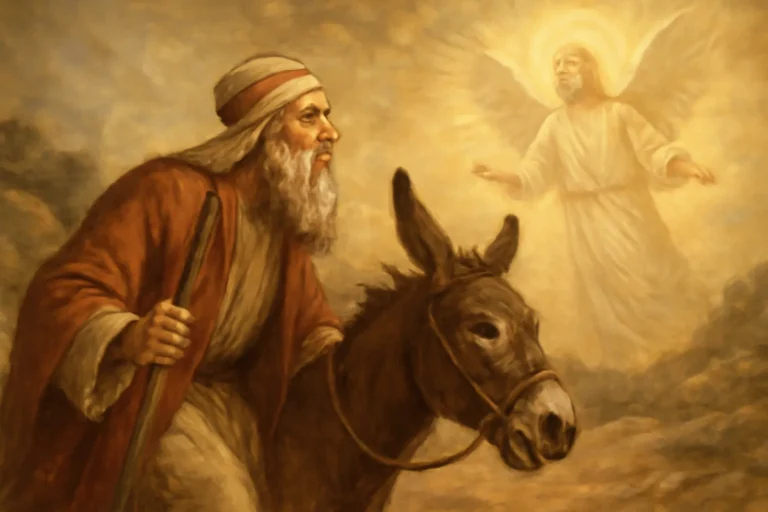
A central dramatic moment occurs when an angel of the Lord stands in Balaam’s path, unseen by the seer but visible to his donkey. The animal senses danger and refuses to pass, a behavior that enrages Balaam, who proceeds with a rebuke and a beating. The narrative underscores a crucial theological claim: God’s messengers and will cannot be manipulated by human fear or worldly wisdom. The angel’s declaration, “If it is a discipline you have come by your own strength, you will perish,” casts a long shadow over the prophet’s ambitions and calls him to accountability.
This encounter is not merely a scene of miraculous oddity; it is a pedagogical moment about discernment. The donkey’s behavior becomes a mirror for Balaam’s conscience. When a creature reacts to divine presence with restraint and resistance, the human agent has an opportunity to reflect: whose voice dominates, and whose will is prevailing in decisions that affect many people?
The Talking Donkey: The First Revelation to the Reader
The turning point of the narrative is the moment when the donkey speaks. The beast asks Balaam a pointed question: “What have I done to you, that you have struck me these three times?” The donkey’s voice, speaking in a coherent and moral register, shifts the entire frame of responsibility. The reader is invited to witness a dialogue that exposes Balaam’s inner contradictions. The talking donkey does not debate theology in the abstract; instead, it challenges a human prophet’s inability to see the divine road ahead.
The Donkey as Moral Disciple
Many interpreters note that the donkey’s perspective provides a counterpoint to Balaam’s arrogance. The animal’s reluctance is a form of ethical signaling, a nonhuman witness to the peril of disobedience. The donkey’s question—embedded in the context of danger—frames the dialogue as a moral lesson: obedience to God, not expediency, is the true measure of a leader or a prophet.
Obedience over ambition: The donkey’s restraint teaches Balaam that obedience to God supersedes plans for gain or prestige.
Recognition of divine will: The moment invites Balaam to align his path with divine purposes rather than personal interest.
Humility before revelation: The animal’s speech becomes a mirror: who really understands the situation—human power or divine presence?
The Dialogue: Balaam and His Donkey
When Balaam finally opens his eyes to see the angel, the gravity of the moment becomes explicit. The dialogue that follows between the prophet and his beast of burden reframes Balaam’s authority. The text shows a shift from a transactional prophet who negotiates with heavenly orders to a recipient of divine correction who must adjust his stance before God.
This section of the narrative reveals a layered truth: human speech can be both a tool of blessing and a conduit for greed or fear. Balaam’s willingness to receive instruction, even from a donkey, is portrayed as a turning point. The donkey’s insistence on safety lines up with a broader biblical value: God’s priorities for life often outrun human calculations about profit, pride, and power.
The Moment of Insight
The turning point comes when Balaam is allowed to see what he could not previously perceive: the divine purpose that surpasses national interests and personal gain. The angel’s words—conveyed through a non-traditional messenger—reframe the journey from a quest for reward to a course of obedience. For students of theology, this moment provides a case study in prophetic humility and the risk of misreading signs.
The Oracles: Balaam’s Blessings on Israel
The most widely studied portion of Balaam’s journey consists of the oracles he proclaims after Balak’s attempts to secure a curse fail. Instead, Balaam pronounces blessings that celebrate Israel’s destiny and deliverance. These oracles present a radical theological claim: God’s favor rests on the people of Israel, and those who seek to thwart that blessing encounter limits placed by divine sovereignty.
The content of the oracles emphasizes themes such as favor, redemption, and divine protection. The prophet’s mouth becomes an instrument through which God’s purposes for Israel are made plain. The drama of the journey—marked by the textual switch from attempt to curse to pronouncement of blessing—illustrates a deeper truth: prophetic voice is measured not by wealth or status but by fidelity to God’s truth.
The Three Oracles and Their Themes
The three oracles provide a progressive cultivation of revelation. They begin with a general blessing that speaks of victory and safety, proceed to cosmic imagery of God’s sovereignty, and culminate in a prophetic vision praising Israel as God’s own possession. Each oracle reinforces a core principle: God’s will transcends human plots, and true prophetic utterance aligns with God’s character and purpose.
First oracle: A blessing that counters Balak’s expectation of a defeat and exposes the futility of bribery or coercion.
Second oracle: A cosmic assertion of God’s supremacy, transcending national power and human strategy.
Third oracle: A more explicit commendation of Israel’s righteousness and deliverance, inviting the audience to reconsider what it means to be blessed by God.
The Donkey as Teacher: Theological and Ethical Interpretations
The talking donkey, as a pedagogical figure, invites multiple layers of interpretation. Jewish, Christian, and Islamic commentators have offered reflections on how this episode illuminates God’s method of revelation, the integrity required for spiritual leadership, and the dangers of greed and political manipulation.
Jewish Readings and Rabbinic Echoes
In Jewish interpretive tradition, Balaam’s tale is often read as a cautionary tale about the danger of allying with power divorced from righteousness. The donkey’s role emphasizes the moral order of creation: even a humble creature can discern the divine topography better than a human agent driven by ambition. Rabbinic voices frequently highlight Balaam’s struggle to reconcile personal profit with divine instruction, using the donkey’s question as a mnemonic for the importance of humility before God.
Christian Theologies and the Cross of Prophecy
Christian theologians have seen Balaam’s journey as a typology of prophetic vocation, illustrating how God can work through imperfect vessels to accomplish his purposes. The imagery of the talking donkey has become a symbol of divine permission for unlikely instruments to speak truth to power. The narrative also invites readers to compare Balaam’s blessings with the messianic hope later found in Christian thought, where God’s ultimate blessing is extended to all nations through divine action in history.
Islamic Perspectives and Shared Moral Ground
In Islamic tradition, Balaam is recognized as a figure bound up with the complexities of prophecy, human free will, and divine testing. The Qur’anic and hadith-based commentaries emphasize admonitions against greed and the temptation to seek gain through misusing spiritual authority. The story of a speaking beast in this broader tradition resonates with the ethical insistence that true guidance comes from God and that human beings must submit to spiritual truth rather than to personal gain.
Practical Applications: Wisdom for Today
The Balaam narrative, including the talking donkey episode, offers a repertoire of ethical and spiritual lessons that remain relevant for contemporary faith communities, leaders, and individuals.
Discernment over desire: The episode highlights the need to distinguish God’s voice from personal ambition or political calculation.
Humility as a moral posture: Leaders and prophets must approach moral authority with humility, recognizing that power can corrupt or distort truth-seeking.
Integrity in motive: The danger of accepting compensation for voicing a desired outcome underscores the importance of motives in prophetic or leadership roles.
Obedience to divine direction: Even when circumstances seem advantageous, obedience to God’s leading remains paramount.
God’s sovereignty over history: The narrative reinforces that human plans are subordinate to divine purposes, and that God can redirect events in surprising ways.
Beyond the surface narrative, the Balaam account invites readers into deep theological reflection. Several themes emerge with striking clarity:
Divine sovereignty: God’s will prevails over royal schemes and prophetic pretensions, reminding believers that ultimate authority rests with the Creator.
Communication across boundaries: God speaks through a nonhuman vessel, challenging the assumption that divine speech must arrive only through approved human channels.
Ethics of prophecy: The text invites ongoing ethical inquiry into how prophecy should be conceived, proclaimed, and tested against the common good.
Mercy and judgment: The oracles reveal God’s steadfast mercy toward Israel while also warning against obstructing God’s purposes.
Prophetic integrity versus political manipulation: Balaam’s arc is a case study in whether prophetic voice remains true when money, honor, or power are at stake.
Cross-Text Reflections: Parallels and Divergences
The Balaam narrative shares motifs with other ancient Near Eastern texts and biblical stories. Thinkers have drawn thoughtful parallels to stories of divine message delivery, prophetic testing, and the moral hazards of wealth and prestige. However, the distinctive feature of this story is its robust insistence on the centrality of God’s will over human expediency. The talking donkey becomes a cultural symbol for the necessity of listening to the divine voice, even when it comes through unlikely means.
The Donkey’s Perspective Reconsidered: Reframing the Text
Modern readers often engage Balaam’s journey through the lens of moral psychology or leadership studies. Yet the donkey’s inner life—though not described in psychological terms—offers a model for reflective practice. The donkey’s refusal to move at the angel’s command mirrors enduring ethical insistence: safety, justice, and fidelity to God’s command must guide action, not mere compliance with a human patron’s plan.
Common Misunderstandings and Clarifications
In approaching the Balaam tale, several misreadings commonly occur. It is important to distinguish:
Misunderstanding: Balaam is purely a villain. Clarification: The narrative portrays him with complexity—he is drawn toward a higher claim to truth, yet he also succumbs to greed and political temptation. The donkey’s rebuke invites moral self-scrutiny rather than a simplistic judgment.
Misunderstanding: The talking animal invalidates prophecy. Clarification: The miracle underscores God’s freedom to use any vessel for divine purposes and highlights the necessity of divine validation for true prophesy.
Misunderstanding: The blessings in the oracles negate the danger Balak posed. Clarification: The narrative acknowledges threat to Israel but confirms that God’s purposes are stronger than human schemes, even when those schemes involve religious manipulation.
A Closing Reflection: The Living Relevance of Balaam and the Talking Donkey
The saga of Balaam’s journey and the talking donkey remains resonant for readers who navigate modern landscapes of leadership, media, and public discourse. In an era of political spin and moral ambiguity, the tale challenges communities to seek truth with humility, to test voices against God’s revealed will, and to recognize that true guidance may arrive in unexpected forms. The biblical record thus invites ongoing reflection on how prophecy functions ethically within a community, how leaders should respond to correction, and how faith communities discern the line between divine instruction and personal interest.
To study Balaam and the talking beast is to engage with a narrative that refuses to reduce spiritual life to simple categories. It is a dynamic invitation to examine one’s own motives, to honor divine authority, and to embrace the complex, but ultimately transformative, truth that God speaks, even through the most unlikely voices.
Quick Takeaways: Practical Reflections for Lectures, Bible Study, and Personal Faith
Discernment matters: Always test prophetic claims against the character and will of God as revealed in Scripture and community tradition.
Leadership ethics: Wealth, honor, or political advantage should not be the primary motivator for prophecy or guidance.
Humility before revelation: Acknowledging that we can be corrected—even by a donkey—preserves authentic spiritual integrity.
Scriptural breadth: The Balaam account invites readers to synthesize insights from Jewish, Christian, and Islamic readings for a richer theology of prophecy.
Pastoral application: In preaching or teaching, use the donkey’s voice to teach about listening to God’s word even when it disrupts expectations or plans.