
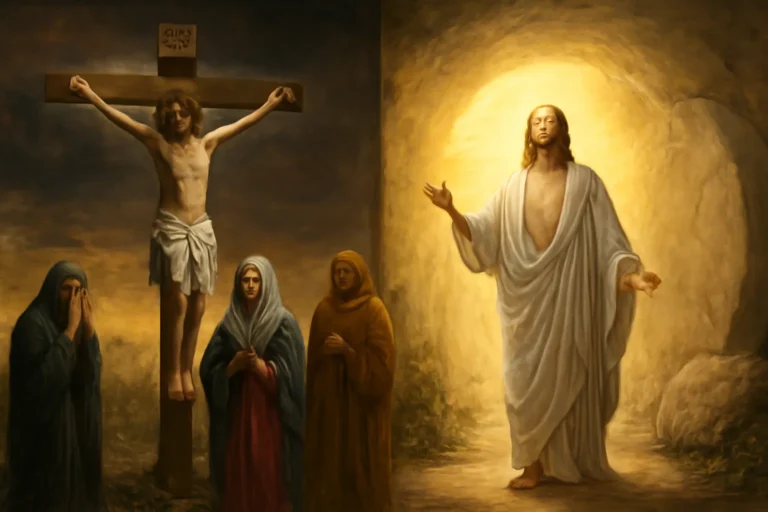
The topic of Crucifixion and Resurrection stands at the center of Christian faith and imagination. The phrase the Easter story conjures a sequence of events that begins with betrayal and desertion, moves through suffering under Roman authority, culminates in death on a cross, and then unfolds as the most transformative moment in history—the appearance of the risen Christ and the dawn of a new humanity. This long-form exploration surveys the narrative contours, theological meanings, historical contexts, and liturgical reverberations of Christ’s death and Christ’s resurrection, sometimes called the Passion narrative and the Paschal mystery in different Christian traditions.
Across centuries and cultures, theologians, pastors, lay readers, and scholars have engaged with the Easter cycle not merely as a commemorative tale but as a living interpretive frame. It is a story that answers questions about life, suffering, justice, forgiveness, and hope. It is also a story that invites continual re-reading—through sermons, sermons, hymns, artworks, creeds, and scholarly exegesis—so that communities can discern how the event of the Cross and the reality of the Empty Tomb shapes ethics, worship, and mission today.
Historical Anchors and Scriptural Foundations
The Easter narrative draws its core material from the four canonical Gospels—Matthew, Mark, Luke, and John—each offering a distinctive emphasis while converging on the central facts: the suffering and crucifixion of Jesus, his burial, and his subsequent appearances after death. In addition to the Gospel accounts, early Christian writings, creedal formulations, and liturgical practices reveal how the crucifixion and resurrection were perceived as decisive events that rendered meaning to a community in need of hope.
- Gospel portraits: Each Gospel presents a unique theological angle—Matthew’s narrative foregrounds fulfillment of prophecy and instruction in community ethics; Mark emphasizes the secrecy and messenger-appointment motifs; Luke highlights compassion for the marginalized and the path from sorrow to joy; John emphasizes intimate encounters with Jesus as the risen Word.
- Historical context: The crucifixion occurred within a Jewish-Roman milieu, where political tension and theological expectations intersected in complex ways. The resurrection, then, was interpreted by early Christians as not merely a resuscitation but a re-entrance of divine life into human history, inaugurating a new creation in which death did not have the final say.
- Formation of belief: Early Christians used a combination of eyewitness testimony, prophetic scriptural interpretation, and experiential encounters to articulate what would become the core proclamation: Jesus is risen, and through him the promise of redemption and new life extends to all who believe.
This section introduces a broad framework. In exploring the Crucifixion as the event of the Cross and the Resurrection as the triumphal turning point, we aim to reflect on how the Easter narrative functions within faith communities and how it can be intelligible to readers today, across cultures and theological traditions.
The Crucifixion and the Passion Narrative
Overview of the Passion
The term Passion encompasses the suffering, arrest, trial, and execution of Jesus, culminating in his death on a cross. In the Easter story, the crucifixion is not merely a historical event; it is interpreted theologically as a decisive act in which Jesus bears the weight of human sin, solidarity with the broken, and the defeat of spiritual powers associated with death.
Theological textures of Christ’s death
Theologically, Christ’s death is understood in several interpretive strands:
- Atonement theories that speak of reconciliation between God and humanity, often described in terms of debt paid, penalty endured, or domination by evil overcome.
- Christus Victor imagery emphasizes liberation from the power of sin and death through a victorious act.
- Penal substitution views highlight judgment satisfied on behalf of sinners.
- Moral influence perspectives emphasize the transformative effect of self-giving love on observers and communities.
- Ransom concepts discuss a liberating price paid to release captives from bondage to sin or death.
While these lines of thought diverge in emphasis, they converge in the shared conviction that Jesus’ death reveals God’s solidarity with the broken and opens a path toward healing for the world.
Elements of the crucifixion narrative
- The betrayal by a close ally and the abandonment by the crowd in a time of crisis.
- The trial under Roman authority, with political and religious charges intersecting.
- Imprinting of the Cross as a symbol of shame transformed into a symbol of divine love and justice.
- The moment of death and the request for burial by Joseph of Arimathea, signaling a new place of honor and a sign of hope for the marginalized.
Death, Burial, and the Sabbath Silence
The death of Jesus is followed by a careful burial, with the Sabbath interrupting the narrative with a period of stillness. The investiture of Jesus’ body in burial cloths, the sealing of the tomb, and the placement of a guard are events that the Gospel writers describe to emphasize the dramatic shift that will occur in the Easter morning.
The silence of the tomb becomes a powerful sign for early believers: if death can hold the body, then the risen life must be more profound than any ordinary human experience. The Easter morning, then, is announced not simply as a return to life but as a transformation that reveals a divine prerogative to bring life from death and hope from despair.
- Women at the tomb—in multiple accounts, women are the first witnesses to the empty tomb and to the earliest proclamations of the resurrection.
- Guard and stone—the practical details of the tomb’s sealing and the guarding suggest that the event to come would be recognized as extraordinary beyond human control.
- Women’s testimony plays a crucial role in the narrative, challenging social norms of the time while underscoring the theme that the risen Jesus appears first to those who would otherwise be overlooked.
The Resurrection Morning and Post-Resurrection Appearances
The Empty Tomb and the Proclamation
The Resurrection morning is framed around the discovery of an empty tomb, followed by angelic announcements and the immediate challenge to the disciples’ expectations. The rising life is presented not as a resuscitation of a corpse but as a theological event that redefines reality—death is not final; God has acted to establish a new order.
Appearances of the risen Christ
The narrative moves from the empty tomb to appearances: to Mary Magdalene, to a group of followers, to individuals who encounter Jesus in journeys or inside rooms, and finally to notable post-resurrection dialogues with Peter and the disciples. These appearances validate the claim that the risen Christ is alive, speaking, and transformative.
- Encounter with Mary Magdalene marks a personal and intimate confirmation that the risen Jesus is distinct from a mere spiritual apparition.
- Road to Emmaus narrative emphasizes the interpretive power of Scripture as Jesus opens minds to understand the scriptures in light of his suffering, death, and resurrection.
- Petitions and commissions—the risen Jesus commissions his followers to proclaim the Good News and to carry forward a mission that extends beyond the local circle of disciples.
In many Christian theologies, the Easter morning culminates in Pentecost—the outpouring of the Holy Spirit that empowers the church to live in the light of the resurrection and to embody the values of the kingdom of God in the world.
Theological Reflections on the Resurrection and its Significance
Identity and mission
The resurrection reshapes identity. Followers of Jesus are invited into a new orientation whereby fear yields to courage, despair yields to hope, and isolation yields to belonging. The risen Christ becomes the primary reference point for faith and the source of authority for the church’s teaching and practice.
Atonement and new creation
The Easter event is often read as the inauguration of the Paschal mystery, a term used especially in Eastern Christian theology to describe the culmination of Christ’s redemptive work as the gateway to a new creation. Through the Resurrection, the order of life is reconfigured; what was broken is reconstituted, and what was dead is given the gift of eternal life.
Resurrection variety across Christian traditions
Different Christian traditions emphasize aspects of the resurrection that resonate with their liturgical, theological, and pastoral concerns:
- Roman Catholic and Anglican theologies often stress continuity with the apostolic witness, the sacramental life, and the renewal of hope in the face of suffering.
- Orthodox theology typically foregrounds the mystery of the Resurrection (anastasis) as a cosmic drama that touches all creation and is celebrated with a theology of light and triumph.
- Protestant perspectives frequently highlight justification by faith, the redemptive sufficiency of Christ’s work, and the ethical implications for justice and mercy in daily life.
Why the Easter Narrative Matters for Faith Communities
Faith, hope, and ethical transformation
The Easter narrative offers a robust account of hope in the face of suffering and injustice. It invites communities to live with integrity, to practice mercy, and to pursue peace in a world that still experiences brokenness. The message of the Resurrection is not merely about personal consolation; it is about a public and social dimension—a call to enact a more just and compassionate order in which life is valued at every stage and for every person.
The church’s worship and proclamation
In worship, the Easter narrative is celebrated through symbols, songs, liturgical rites, and sacraments. The central proclamation—“Christ is risen”—is repeatedly confessed, recited, and embodied in the daily life of communities. The liturgical year’s arc from Holy Week to Eastertide is designed to guide believers through a journey from despair to joy, from lament to praise.
- Creeds articulate essential convictions about Jesus’ death and resurrection and their salvific significance.
- Liturgies mark the sacred moments of Holy Week, including Maundy Thursday, Good Friday, Holy Saturday, and Easter Sunday, enabling believers to traverse the narrative with reverence and gratitude.
- Ethical implications emerge from the resurrection—the demand for justice, mercy, forgiveness, and peacemaking in a complex world.
Easter Across Traditions and Cultures
The contour of the Easter story shifts across geographic and cultural lines, offering a tapestry of meanings that can deepen the universality of its message. In some Orthodox contexts, the term Pascha emphasizes the Passover dimension of freedom from bondage; in Western churches, Easter often emphasizes the triumph over sin and death and the vindication of divine justice.
Global expressions of the Easter proclamation
- Orthodox Pascha emphasizes the mystery of the Resurrection as a luminous and cosmic victory that permeates creation.
- Catholic Easter highlights the Paschal Mystery as the central mystery of faith and the seed of the Church’s mission in the world.
- Protestant Easter centers on the historical resurrection event and its implications for salvation, faith, and ethical living.
- Liberation theologies read the Easter story as a call to confront oppression and to pursue liberation for the marginalized and the oppressed.
Across cultures, Easter rituals may include processions, vigils, sunrise services, almsgiving, and festive meals. These practices reflect a sense that the Easter morning is not simply a memory but a present invitation to live in the power of the risen life.
Art, Music, and Literature as Mediators of the Easter Story
The Easter narrative has inspired a vast array of artistic expressions. Visual art, music, poetry, drama, and narrative literature have sought to translate the mystery of Christ’s death and Christ’s resurrection into accessible experience for people across eras.
- Iconography in Orthodox churches depicts scenes of the Resurrection and the Anastasis, inviting contemplative remembrance and liturgical participation.
- Passion plays and musical settings of the Easter story convey the emotional arc of betrayal, trial, sacrifice, and triumph with vivid dramatic force.
- Poetry and hymnody caress the ache of the Cross and celebrate the joy of the Empty Tomb, shaping personal devotion and communal worship.
These cultural forms help believers, and drew-in audiences beyond the church walls, to encounter the Easter message with imagination—an essential dimension of how the Easter story remains relevant in modern society.
Approaches to Interpreting the Easter Story Today
Historical-critical and literary readings
Critical scholarship can illuminate the historical contexts of the Gospel narratives and their intended audiences. Readers can explore questions of sources, literary genres, and the ways early Christians reframed Jesus’ death and resurrection in light of their memory of Jesus and the events surrounding him.
Theological reflections and pastoral application
The Easter story invites ongoing theological reflection. Pastoral care often centers on offering comfort to those who grieve, alongside guidance on how to interpret suffering through the lens of resurrection hope. The narrative challenges believers to translate faith into compassionate action in the world.
Ethical and social implications
The resurrection’s ethical radius includes a call to justice, reconciliation, and care for the vulnerable. It also invites communities to resist cynicism and to foster resilience in the face of hardship, drawing strength from the conviction that life and dignity prevail in the light of divine love.
The Easter Story as a Living Narrative
The crucifixion and resurrection of Jesus—the Easter narrative—continues to live in the practices, beliefs, and hopes of Christian communities around the world. It is not a static memory but a living declaration: that love conquers death, that forgiveness can restore broken relationships, and that a community of faith can embody a new creation in the midst of a world that longs for renewal.
Throughout history, believers have been drawn to this central claim in diverse ways. Some readers focus on the historical questions surrounding the crucifixion and the evidence for the resurrection; others emphasize the experiential dimension—the transforming presence of the risen Christ in daily life. Still others center on the communal and ethical implications: how a church lives out the message of the Easter day in acts of mercy, unity, and service.
In closing, the Easter story—anchored in Christ’s death and the Resurrection—offers a framework for understanding the world, the problem of suffering, and the possibility of renewal. It invites readers to encounter the risen Lord, to trust the promises of God, and to participate in a mission that seeks both personal transformation and societal justice.