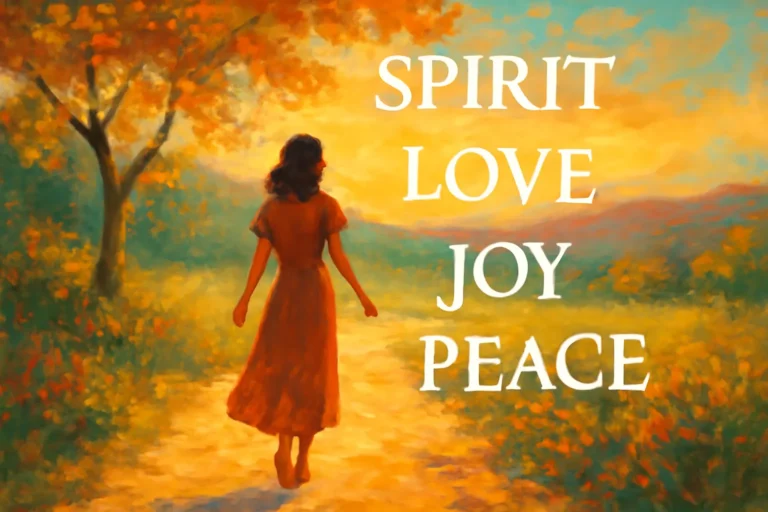
This long-form article offers a comprehensive exploration of Walking by the Spirit as a distinct way of life within the Christian tradition. The phrase often evokes a radiant pattern of Love, Joy, and Peace that some describe as the visible fruit of a Spirit-led journey. Here we survey biblical foundations, theological interpretations, historical developments, and practical pathways for cultivating a life that is guided, empowered, and transformed by the Spirit. The aim is educational, pastoral, and reflective, inviting readers to consider how the Spirit’s presence shapes belief, worship, ethics, and everyday conduct. Throughout the article, you will encounter variations on the theme—walking by the Spirit, living by the Spirit, being led by the Spirit—each contributing to a fuller understanding of a life aligned with divine intention.
Foundations in Scripture: The Spirit as Guide and Source of Life
The biblical portrait of a Spirit-guided life begins with God’s own work within human beings. The apostolic writings describe a movement from self-reliance toward dependence on the Spirit, a journey that reorients desire, intention, and action toward God’s purposes. In many Christian traditions, the motif of walking by the Spirit serves as a compact summary of a life conformed to divine leadership.
Old Testament glimpses of a Spirit-led life
Long before the term Walking by the Spirit appears in Christian writings, the Old Testament acknowledges moments when the Spirit of God animates people for service, prophecy, and renewal. Phrases such as “by the Spirit of the Lord” point to a dynamic work of God energizing human beings beyond ordinary strength. In foundational terms, the Spirit is not merely an influence but a personal presence that empowers obedience, courage, and hope.
- Empowerment for service—Prophets, judges, and leaders often receive a divine enablement that enables them to fulfill vocations beyond natural capacity.
- Renewal and aspiration—The Spirit is associated with renewal of heart and mind, beginning a longing for righteousness that outpaces mere outward conformity.
- Vision and discernment—The Spirit inspires clarity of purpose and the courage to pursue justice in the face of opposition.
New Testament teachings: Galatians, Romans, and Jesus’ teachings on the Spirit
In the New Testament, the pattern becomes more explicit. The Apostle Paul, writing to congregations in Galatia and beyond, contrasts the life according to the “flesh” with the life animated by the Spirit. In Galatians 5:16–26, the apostle invites believers to walk by the Spirit, signaling a continuous orientation toward God that manifests in characteristic fruit. Similar themes appear in Romans 8, where life “in the Spirit” becomes the new ontology for the believer, releasing freedom from sin and enabling righteous living.
- Walking by the Spirit as a daily discipline that aligns choices with God’s will.
- Reception of the Spirit at conversion and ongoing sanctification through baptismal and creedal life.
- The Spirit as advocate and teacher who illuminates Scripture and enables prayer.
The gospel narrative advances the reader’s expectation: the Spirit does not merely inspire inward emotion; the Spirit generates a transformed pattern of living. The verb forms and metaphorical language used in Greek correspond to a dynamic walk—step by step, moment by moment—rather than a one-time decision. Throughout the canonical writings, to walk by the Spirit is to let the Spirit’s presence dictate perception, motive, and action.
Theological Vision: The Spirit as Comforter, Advocate, and Guide
Trinitarian context: The Spirit within the Triune God
The Spirit’s work is best understood within a Trinitarian framework. The Spirit is not a force detached from the Father and the Son; rather, the Spirit proceeds from the Father, is sent by the Son, and is intimately involved in the life of believers. This sacred partnership makes the Spirit-led life a cooperative journey—one in which human agency and divine initiative interweave.
In practical terms, the Spirit functions as comforter in times of distress, guide in decision, and sanctifier shaping character over time. The theological language emphasizes both divine initiative and human response: God acts; people respond by faith, trust, obedience, and love.
Character and commission: how the Spirit shapes virtue
The Spirit’s influence is not merely about personal piety; it is about communal flourishing and ethical integrity. A Spirit-led life produces enduring virtues that are observable in relationships, worship, and mission.
- Comfort in weakness and spiritual consolation that sustains endurance.
- Truth-telling discernment that helps believers distinguish between competing voices and false teachings.
- Peaceful courage that speaks truth with gentleness and resilience in conflict.
- Congruence between belief and behavior—the life matches the confession, not by human strength but by divine enabling.
The Spirit is envisioned as a divine counselor who helps interpret Scripture, shapes conscience, and fuels mission. In this view, walking by the Spirit is both a personal devotional posture and a social vocation—forming communities where love, joy, and peace can be learned, practiced, and shared.
Love, Joy, Peace: The Core Fragrance of a Spirit-Led Life
Among the most prominent moral and spiritual expressions of the Spirit’s work are the fruits of the Spirit—especially love, joy, and peace. These three virtues function as a triad that not only characterizes individual disciples but also defines the atmosphere of communities that embody a Spirit-led way of living.
Interpreting the triad: love, joy, peace in sequence and symbiosis
The sequence often appears in Pauline lists, yet the triad speaks in a unified, interconnected key. Love grounds the other two: it is the motive that animates joyful trust and the peace that results from reconciled relationship with God and neighbor. Joy expresses a confident gladness that exists irrespective of circumstantial change, rooted in the character of God and the hope of vindication. Peace represents the settledness that comes from knowing God’s purposes prevail and from living within the reconciled order of creation.
- Love as self-giving affection that seeks the good of others, even at personal cost.
- Joy as vibrant interior confidence that God is at work, producing gladness that is not contingent on external success.
- Peace as harmony within the soul, within relationships, and within communities, even amid struggle.
The fruit of the Spirit is not an achievement by human power but a divine fruitfulness that grows as believers submit to the Spirit’s leading. The presence of love, joy, and peace within a community signals a life oriented toward God, inviting others to inquire about the source of such transformation.
Semantic breadth: variations on walking by the Spirit and the triad
To capture the breadth of this theme, one may encounter several related formulations:
- Walking by the Spirit or walking in the Spirit—emphasizing ongoing, habitual posture.
- Living by the Spirit—emphasizing the whole life as permeated by divine agency.
- Being led by the Spirit—emphasizing responsive obedience and receptive discernment.
- Spirit-empowered love, Spirit-formed joy, Spirit-granted peace—emphasizing the source and function of each virtue.
Across scriptures and traditions, the triad remains a reliable beacon: if love dominates, joy sustains, and peace orders relationships, a church or community is likely being shaped by a Spirit-led axis rather than by mere human effort.
Practical Living: How to Walk by the Spirit in Daily Life
Knowing what the Spirit intends is one thing; living it out is another. The following practical considerations offer guidance for individuals and communities seeking to embody a Spirit-led life. They are organized around daily disciplines, communal practices, and an overarching posture of humility and reliance on God.
Daily disciplines for a Spirit-led path
- Scripture meditation and attentive listening for what God is saying today.
- Prayerful discernment that seeks alignment with God’s purposes rather than personal preference.
- Submission to obedience even when the path is difficult or unclear.
- Repentance and reconciliation as ongoing practices within personal and relational life.
- Mindful gratitude that recognizes the Spirit’s work in ordinary moments.
Community life: loving one another in the Spirit
- Mutual edification through encouragement, correction, and accountability anchored in love.
- Hospitality and peacemaking as tangible expressions of peace-bearing presence.
- Service and generosity as concrete demonstrations of love that flows from the Spirit’s empowerment.
- Worship and unity—shared practices that align heart and mind toward God and neighbor.
In practical terms, walking by the Spirit calls believers to resist patterns driven by fear, pride, or autonomy, and to cultivate habits that foster love, joy, and peace in both private life and public witness.
Discernment and challenges: staying faithful in a complex world
The Spirit’s guidance is not always obvious, and discernment often requires humility, community input, and an ongoing posture of dependence. Common challenges include balancing spiritual enthusiasm with sober judgment, avoiding ethical extremes, and navigating cultural pressures that pull in conflicting directions. A Spirit-led life invites sustained prayer, scriptural fidelity, and a willingness to adjust paths in response to God’s gentle leading.
Historical and Ecclesial Perspectives: How Generations Have Interpreted the Spirit-Led Life
Across Christian history, theologians, pastors, and laypeople have offered varying emphases on how to understand “walking by the Spirit.” While the core convictions remain consistent—Spirit-led life, ethical transformation, hopeful trust—historical contexts shape expression and emphasis.
Early church and patristic reflections
In the earliest centuries, the Spirit was celebrated as the source of unity in the church and the empowerment for mission. The early church fathers spoke about the Spirit’s indwelling presence as the source of new life and communal vitality. Their reflections laid groundwork for later debates on how the Spirit works through preaching, baptism, and Eucharistic life to form a people marked by virtue, hospitality, and steadfast faith.
Pietist and Reformation-era emphases
The Pietist and Reformational movements emphasized personal conversion, sanctification, and a practical spirituality that rhymes with contemporary understandings of the Spirit-led life. They urged believers to cultivate heartfelt devotion, social responsibility, and a living concern for others—dimensions that align with the love, joy, and peace that define the Spirit’s fruit in action.
Modern pastoral perspectives
In modern contexts, theologians and pastors explore how the Spirit interacts with culture, psychology, and social ethics. The Spirit’s work is often discussed in terms of transformation that touches identity, vocation, and community flourishing. This broader lens highlights how the Spirit can catalyze movements of reconciliation, justice, and healing while remaining grounded in biblical truth.
Case Studies: Illustrations of a Spirit-Led Life
Concrete examples can illuminate how the ideals of Walking by the Spirit translate into everyday realities. The following brief case studies illustrate how love, joy, and peace become practical realities within varied settings.
Case Study A: A neighborhood outreach driven by love
In a community marked by tension, a group of neighbors begins to walk by the Spirit by prioritizing listening, hospitality, and shared meals. They practice gentleness and self-control when disagreements arise, and they persevere in prayer for their neighbors. Over time, trust grows, and the group becomes a bridge for reconciliation and mutual aid.
Case Study B: A church persevering in joy amidst trial
A congregation facing economic strain and internal division decides to anchor itself in the Spirit’s gifts. They cultivate liturgical rhythms of gratitude, communal singing, and acts of service, fostering joy that is not dependent on circumstances. The resulting atmosphere of peace and shared purpose strengthens both worship and witness.
Case Study C: Youth ministry and discernment
A youth group wrestles with questions about identity, media, and peer pressure. Guided by leaders who model discernment and rely on the Spirit, students learn to distinguish between passing trends and durable values. The practice of prayerful discernment helps them live by the Spirit in decisions about friendships, media use, and vocation.
Common Questions and Clarifications About Walking by the Spirit
What is the difference between walking by the Spirit and following the law?
Walking by the Spirit is not a rejection of moral law but a transformation that enables deeper obedience and a motive grounded in love. The Spirit enables believers to fulfill the law’s deepest intent (justice, mercy, faithfulness) while providing the energy and orientation necessary for enduring faithfulness.
Is experiential emotion essential to being Spirit-led?
Not necessarily. The Spirit’s work may be experienced as inner peace, conviction, or a sense of divine grace; however, robust evidence of walking by the Spirit includes purposeful love, resilient hope, and communal harmony—even when emotional highs are absent.
How do we measure whether we are growing in love, joy, and peace?
Growth is often visible in relationships, mission, and daily choices. Consider asking:
- Are my actions increasingly shaped by love toward others, even when it costs me personally?
- Do I experience a stable inner joy that persists through challenges?
- Is there a growing peace that quiets anxiety, fosters reconciliation, and promotes unity?
Philosophical Reflections and Ecumenical Perspectives on the Spirit-Led Life
Beyond a strictly doctrinal setting, scholars and theologians in various Christian traditions wonder how the Spirit’s work intersects with reason, freedom, and moral agency. The concept of walking by the Spirit invites a posture of humility: recognizing human limitation while trusting in divine empowerment. The ecumenical conversation often centers on how diverse communities can articulate a coherent practice of love, joy, and peace while honoring distinct ecclesial cultures and theological emphases.
Ethics, freedom, and the Spirit
A recurring theme is how the Spirit’s presence cultivates true freedom. The freedom described in Pauline literature involves not libertinism but release from the enslaving patterns of sin and fear, enabling a life that is oriented toward justice, mercy, and neighbor-love.
Ecumenical common ground
Across traditions, there is broad agreement that the Spirit’s work is a unifying gift that enables believers to love, to hope, and to pursue peace with integrity. The differences that remain—such as emphasis on charismatic phenomena, or on the continuity between Spirit and Word—often reflect legitimate theological preoccupations that can be discussed with charity and curiosity.
Conclusion: The Spirit-Led Path as a Way of Life
Walking by the Spirit is a robust invitation to reorient life toward love, sustained joy, and enduring peace. It is not a formula for emotional escape but a pathway for authentic transformation that touches heart, mind, and hands. When a community embraces the Spirit’s leadership, love becomes the language of daily interaction, joy becomes the posture of enduring hope, and peace becomes the common ground that enables vulnerable conversation and constructive action.
This article has explored the concept across Scripture, theology, history, and practical living. It has offered a language for describing the Spirit’s activity and a set of disciplines that can sustain the journey. The walk is iterative: one step of faith leads to another, and each step is taken in community, under the guidance of God’s Spirit who sustains and reshapes. Whether you are a student, a pastor, a layperson, or someone exploring faith, you are invited to contemplate how walking by the Spirit might shape your understanding of love, joy, and peace—and how those virtues might become a shared witness in your neighborhood, your church, and your world.