Across the arc of Christian history, one figure stands at once
transcendent and intimate, cosmic and intimate, sovereign and
relational: Jesus the servant leader. The phrase may
feel paradoxical to a modern ear, where leadership is often linked with
dominance, hierarchy, or control. Yet for readers of the Gospels and for
communities shaped by the Christian narrative, the deepest forms of
leadership are inseparable from humility, service,
and sacrifice. This long-form exploration examines Jesus as
the Servant Leader, tracing biblical foundations, gospel portrayals, and
theological implications that have shaped countless lives, churches, and
movements through the centuries.
In reflecting on the life of Jesus, we encounter a model of authority
that emerges not from asserting power over others but from representing
God’s desire for neighbor-love, justice, mercy, and guidance given
through relational presence. The idea of a servant-leadership
disposition—emphasizing care for the vulnerable, listening before
leading, and laying down one’s life for others—finds its most vivid
portrayal in the Christ-event. The following sections weave together
biblical narrative, theological reflection, historical context, and
practical implications, highlighting how the Servant Leader is
not merely a historical figure but a living pattern for communities of faith
seeking to embody love in action.
The Concept of Servant Leadership in Christian Thought
The term servant leadership travels across disciplines—from
organizational theory to church ethics—but in Christian thought it gains
its most robust meaning when anchored in the person and work of Jesus.
While the phrase as a modern label was popularized in the 20th century by
scholars and practitioners, theological servant leadership is
biblical in origin. The core claim is simple yet demanding: true authority
emerges through service, not suppression; leadership grows
through self-giving love, not self-promotion.
The Biblical Foundation
The Gospels present Jesus as one who embodies and teaches servant
leadership in word and deed. Early in his ministry, he flips common
assumptions about status and rank by inviting the humble, the poor, and
the weary into a table where power is redefined by grace. The gospel of
Mark frames Jesus’ mission with the motif of service—a
servant who fulfills the will of the Father by serving others,
ultimately through suffering.
In the Gospel narratives, Jesus’ interactions with people in
various circumstances reveal a leadership that is attentive, inclusive,
and restorative. He speaks truth with mercy, confronts injustice with
courage, and draws people toward restoration rather than domination. In this
sense, the Servant Leader Jesus models a form of authority that is
trustworthy precisely because it bears the marks of genuine humility, compassion, and self-giving love.
Jesus in the Gospels as Servant and Leader
Across the four canonical Gospels, Jesus is painted with the paradox of
fullness and availability. He speaks with authority, teaches with
clarity, and heals with immediacy, yet he does so from a posture of
service. The gospel accounts emphasize that leadership in the kingdom
of God is measured not by dominance over others but by how one
loves, serves, and bears others’ burdens. This reframing of leadership
resonates with the ancient ethos of stewardship—the idea that
leadership is a vocation of responsibility and care to those entrusted
to one’s care.
The Life of Jesus as a Model of Servant Leadership
To understand Jesus as the Servant Leader, it helps to follow the arc of
his life—from incarnation to cruciform sacrifice—seeing how each phase
illuminates a facet of servanthood. Modeling leadership through service
is not a mere ethical exhortation; it is a narrative about God’s
engagement with the world through a compassionate, intimate, and costly
form of presence.
The New Testament opens with a paradox: the eternal Word becomes flesh
(John 1:14). The incarnation situates leadership inside the limits of a real
human life—sleep, hunger, thirst, pain, and dependence. Jesus’ humility is not weakness but a radical redefinition of
strength. His physical vulnerability becomes the ground of moral
authority. The Servant Leader Jesus does not demand privilege; he gives
himself for others. In Paul’s letter to the Philippians, this kenosis—the
emptying of divine prerogative—is presented as the pattern for all who would
lead in his name.
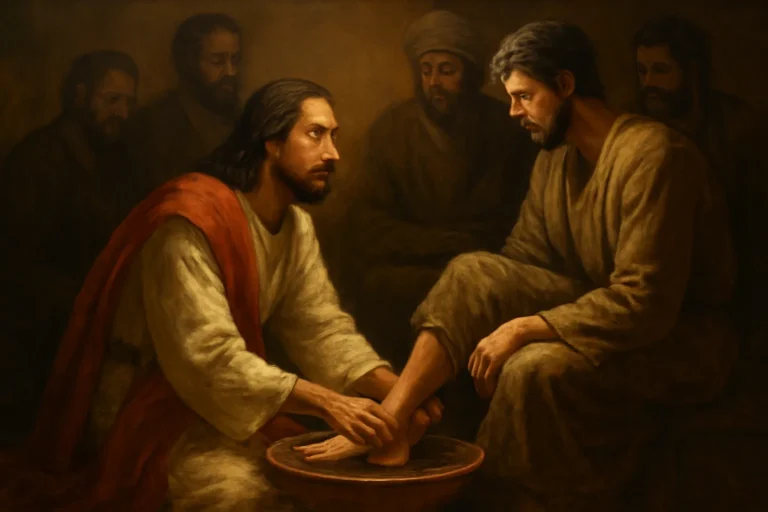
The Washing of the Feet
One of the clearest, most tangible demonstrations of servant leadership is the
incident of the washing of the disciples’ feet (John 13). In a culture where
public status is often tied to social rank, Jesus performs a task reserved
for the lowest of servants. This act embodies the principle that leadership
is service, and that leaders are called to take on the burden of care
for those they guide. For modern readers, the washing of feet invites
reflection on humble service, practical care for neighbors, and a posture
of leadership that seeks to bless rather than dominate.
The response of the disciples—initial discomfort, followed by obedience—
mirrors the journey of many communities when called to practice servant
leadership in messy, real-world contexts: leadership grows through acts
of faithful, sometimes uncomfortable, service.
Parables and Teachings of Servant Leadership
Jesus’ teachings often used parables and memorable sayings to reframe
leadership expectations. These brief, vivid units illuminate the values
of a servant-hearted governance that characterizes the
kingdom of God. They invite readers to consider how leadership shows up in
daily life—around the dinner table, in the marketplace, within family life,
and in moments of conflict.
The Good Shepherd and the Gate
In John 10, Jesus identifies himself as the good shepherd who lays down his
life for the sheep. This metaphor blends leadership with intimate care:
protection, guidance, and self-sacrifice. The shepherd-leader knows the
flock, names the individual sheep, and prioritizes the welfare of all over
personal gain. This vision challenges hierarchies that equate power with
coercion and announces a leadership ethic grounded in care, trust, and risk.
Similarly, parables about the last being first and the first becoming
last reframe worthiness around service rather than social status. The
Servant Leader Jesus often overturns expectations of authority, showing
that true leadership values the vulnerable, honors the overlooked, and uses
influence to heal, reconcile, and restore.
The Cross as the Ultimate Act of Servanthood
The crucifixion stands as the climactic demonstration of servanthood and
leadership intertwined. If leadership is measured by influence and capacity,
the cross reveals its most radical form: a leader who chooses obedience to
the Father over personal comfort, who bears the burden of sin and sorrow
for others, and who conquers the last enemy—death—by surrendering himself
in love.
The instrument of execution becomes a symbol of ultimate service: a
compassionate, self-giving love that welcomes enemies, forgives sin, and
inaugurates a new order in which the weak and the outcast are included in the
circle of grace. The Servant Leader Jesus thus models a leadership that
transcends political power and institutional authority, inviting followers
to participate in a countercultural, transformative mission.
For communities of faith, the cross is not merely a theological
proposition but a practical invitation: to lead in ways that reflect the
cruciform pattern—risk, generosity, mercy, and steadfast fidelity under
pressure. In this sense, the Servant Leader Jesus becomes both exemplar
and source of motive for those who desire to lead in a way that honors God
and serves the common good.
Theological Implications: Authority Through Service
The Christian doctrine of leadership shaped by Jesus involves a shift in
how authority is understood. Rather than a right to command, leadership
becomes a call to responsibility for others’ welfare. This reorientation
has several key theological implications:
Authority as responsibility: Leadership in the Jesus-following
sense is a stewardship that seeks the flourishing of others rather than self-display.
Power under, not power over: The model emphasizes serving with
others, including the marginalized, rather than coercing or dominating.
Love as the measure of leadership: The guiding criterion is whether
leadership expresses sacrificial love and promotes healing and reconciliation.
Conformity to the cruciform path: Discipleship in leadership aligns
with a path that risks, sacrifices, and forgives, following Jesus’ example.
The Servant Leader Jesus thus reframes authority not as a throne, but as a
table—an invitation to shared mission, mutual accountability, and service to
the world. As theologians have noted, authentic leadership in a Christian
frame is less about status and more about identity: who one is in
relation to God and neighbor, and how that identity shapes action in the
world.
Theological Reflections on Sacrifice and Mission
The Jesus who empties himself to serve others becomes the
model for mission—the work of extending mercy, proclaiming the good news,
and embodying justice in tangible ways. The Servant Leader Jesus does not
merely speak about service; he incarnates it in concrete acts: healing the
broken, feeding the hungry, embracing the outcast, and ultimately laying
down his life for the distribution of mercy to all.
Across centuries, Christian communities have wrestled with how this
pattern translates into leadership structures. Some have emphasized
congregational polity and lay leadership as expressions of servant
leadership in community life. Others have highlighted the pastoral and
prophetic functions of church leadership that seek to reflect the loving,
justice-seeking posture of Jesus. In all cases, the question remains:
what would it look like for a church, a school, a hospital, or a
charity to organize around service as the defining mode of authority?
Historical and Ecumenical Context: How Servant Leadership Has Shaped Christian Practice
The influence of the Servant Leader Jesus extends beyond the pages of the
New Testament into history and ecclesial practice. Monastic movements modeled
service and self-denial as a way of following Christ, while many martyr
narratives testify to the courage of leaders who chose poverty, exile, or
risk in order to serve others. More recently, Christian social ethics has been
nourished by the conviction that leadership must engage social injustice,
care for the poor, and advocacy for human dignity.
In ecumenical dialogue, leaders from different Christian traditions have
highlighted the shared conviction that leadership is measured by fidelity to
Christ’s example of love in action. The Servant Leader Jesus thus serves as a
unifying figure across diverse expressions of faith, enabling communities to
collaborate in relief, reconciliation, and the pursuit of justice. Although
theological emphases may differ, the central claim unity: leadership rooted
in service better reflects the gospel’s vision for human flourishing and
divine glory.
Practical Implications for Today: How to Live as a Servant Leader
If Jesus, the Servant Leader, is a template for contemporary life, what does
that mean for individuals and communities today? The following practical
considerations offer a framework for translating belief into action.
Listening first: A servant leader prioritizes listening to the needs, fears, and hopes of others, especially the marginalized. Listening is a leadership act that demonstrates respect and discernment.
Serving in concrete ways: Leadership is expressed through daily acts of service—mentoring, caregiving, volunteering, acts of hospitality, and acts of justice that protect the vulnerable.
Embracing vulnerability: The Servant Leader does not seek to dominate through strength but draws strength from relationships and from God’s presence in weakness.
Accountability and community: True leadership is communal; accountability structures help preserve humility and prevent abuse of power.
Sacrifice without coercion: The model invites sacrifice that is freely chosen for the good of others, not manipulation for personal gain.
In congregations, schools, and nonprofits, these practices translate into
governance that centers service: shaping policies that prioritize the common good,
creating spaces for marginalized voices, and pursuing long-term relational
healing rather than short-term wins. The Servant Leader Jesus thus inspires
leaders to steward resources wisely, advocate for justice, and cultivate an
organizational culture where love is both method and goal.
For families and individuals, the call is equally transformative: leadership in
households and communities becomes a discipline of care—to listen, to forgive,
to provide, and to seek restoration. When love guides decision-making, power
becomes a tool for blessing, not a weapon for advancement. In this sense,
adopting a servant-led posture embodies the gospel’s invitation to live as
neighbors who embody God’s grace in ordinary, daily rhythms.
Interfaith Perspectives and Ecumenical Dialogue
While this article centers on the Christian understanding of Jesus as the Servant
Leader, it is important to acknowledge how leadership themes resonate across
religious traditions. In Buddhism, for example, compassionate leadership and the
alleviation of suffering share a correspondence with the ethic of service. In
Islam, prophetic leadership is often discussed in terms of moral governance, justice,
and care for the vulnerable. In interfaith conversations, the shared priority of
service and mercy offers a common ground for collaboration, while distinct
theological frames provide rich nuance. The aim is not to erase differences but
to illuminate universal values—service, humility, and courage in the face of
need—that can uplift communities in shared public life.
Additional Perspectives: Theological Reflections on Leadership and Love
The ongoing Christian reflection on Jesus as the Servant Leader invites
engagement with a range of scholarly and pastoral voices. Some theologians
emphasize the kenosis motif (self-emptying) as the core of Christ-like
leadership. Others focus on the social implications of Jesus’ ministry—justice,
reconciliation, and the inclusion of the stranger—as central to what it means to
lead in a Christian way. Yet a common thread binds these discussions: true
leadership flows from love enacted in concrete ways, not from control
or self-promotion.
A practical takeaway is to see spiritual authority as relational influence
grounded in integrity, mercy, and dedication to others’ flourishing. For
pastors, educators, clinicians, or public servants who seek to embody
servanthood, Jesus the servant leader offers a horizon toward which to aim:
to guide with grace, to correct with gentleness, and to pursue justice with
perseverance. This is the living tradition of servant leadership
in the Christian context, a tradition that continues to challenge, catechize,
and comfort communities across the world.
Conclusion: The Enduring Model of Jesus as Servant Leader
In sum, the figure of Jesus as servant leader remains one of the
most enduring, debated, and transformative images in religious life. It
challenges conventional notions of power and invites human communities to
envision leadership as a vocation of love, care, and mutual flourishing.
The Servant Leader Jesus is not only a model for旋 historical eras but a
living influence for contemporary conscience. From the earliest church to
modern congregations, from small faith communities to large-scale social
ministries, people encounter a leadership ideal that is less about the crown
and more about the cross—less about ease and more about steadfast faithfulness
under pressure, less about privilege and more about responsibility, and less
about self-serving gain and more about service to neighbors near and far.
As believers contemplate the life and words of the Servant Leader Jesus, they
are invited into a reimagined sense of purpose: to lead by serving, to guide
with tenderness, and to bear witness to a love that conquers fear and fearsome
power alike. Whether one is a teacher, a physician, a community leader, or a
parent, the Christian vision offers a robust call to imitate Christ’s posture of
gracious leadership—an invitation to be, in community, a servant
leader in everyday acts of mercy, justice, and shared hope.