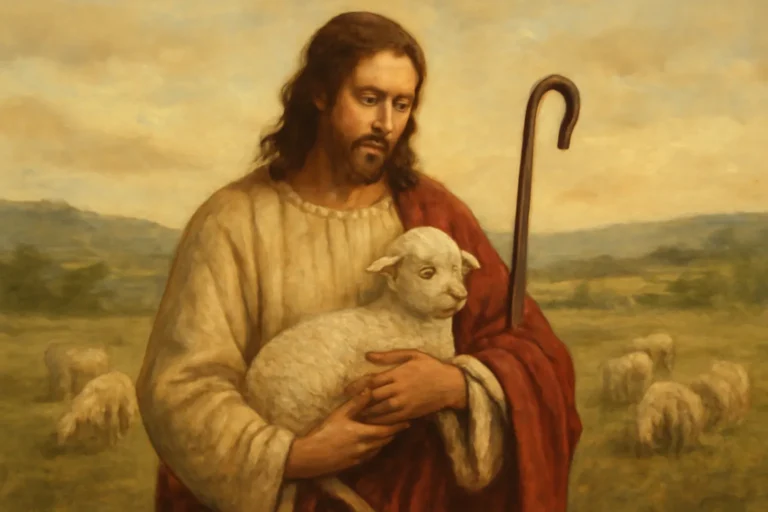

Introduction: The enduring image of the Good Shepherd
In the vast landscape of Christian thought and devotion, there is a single image that has guided
countless believers through times of challenge, uncertainty, and fear: the image of the
Good Shepherd. This symbol, rooted in biblical narrative and expanded through
centuries of interpretation, invites readers to see Jesus not only as Teacher or Prophet, but as
tender caretaker, fearless guardian, and authoritative leader whose influence extends into the
deepest corners of human life. The Good Shepherd Jesus embodies a vocation that is
both relational and cosmic: to know the flock, to lay down one’s life for the sheep, and to lead
them toward green pastures of justice, peace, and truth.
This long-form study begins with the biblical foundations of the shepherd motif, traces its
development through theology and liturgy, and examines how the image shapes pastoral practice in
churches and communities around the world. It considers how the good shepherd metaphor informs
ethics, worship, preaching, and daily living. It also invites reflection on how the shepherd
imagery interacts with other scriptural images—gate and doorway, host and guest, healer and
deliverer—so that the figure of Jesus as the Good Shepherd remains vibrant, challenging, and
deeply consoling for believers across generations.
Biblical foundations: from ancient fields to living tradition
Old Testament precursors: shepherding as a model of leadership
The image of shepherding is ancient and ubiquitous in the biblical world. Before the birth of
Christ, patriarchs and judges are repeatedly described as shepherds, and the shepherd-savior
theme appears in several prophetic voices. In the Psalms, the Lord is portrayed as a shepherd who
cares for the vulnerable, guides in paths of righteousness, and protects from danger. The
Good Shepherd motif thus has deep roots in the language of covenant faith, in which
leadership is inseparable from care, provision, and moral responsibility.
A foundational passage often cited in this context is Psalm 23, which paints a portrait of a
benevolent, providential shepherd who provides, restores, comforts, and guards. The imagery is not
merely pastoral fantasy; it is a theological statement about God’s gracious governance of creation.
In this framework, leadership is measured by sacrifice, attention to the vulnerable, and a
commitment to bring the flock to safety even through dark valleys.
New Testament and Gospel narratives: Jesus as the Good Shepherd
In the New Testament, the Gospel narratives intensify and personalize the shepherd motif. The central
figure of Jesus is described in ways that merge prophetic authority with intimate relational care. Jesus
declares himself to be the Good Shepherd, a statement that functions on multiple levels:
- Relational: He knows his sheep by name and their knowledge of him is mutual and living.
- Dedication: He lays down his life for the sheep, modeling self-giving love.
- Guidance: He leads the flock into safe spaces of truth, moral integrity, and communal harmony.
- Protection: He confronts predators and danger, protecting the vulnerable from harm.
John 10:11-18 is the primary explicit Johannine declaration where Jesus identifies himself as the
Good Shepherd who lays down his life for the sheep. The shepherd image is enriched here by a
sense of intimate knowledge (the shepherd knows the sheep, and the sheep know him), a personal
commitment to the flock, and the unique, relational authority that comes from willingly facing
danger for the sake of others.
Yet the Good Shepherd is not a solitary figure. He is the leader who gathers, teaches, heals, and
sustains a community of believers. The metaphor extends to other New Testament passages that
describe Jesus as the great shepherd of the sheep, who will bring unity and holiness to God’s
people in the eschatological future.
Theological shape: Christology, soteriology, and pastoral care
Christology: the divine-human shepherd in union
The Good Shepherd is at once extraordinary and intimate, divine and approachable. Theologically, this
depiction emphasizes the incarnation and the depth of God’s solidarity with human beings. The image
suggests that God’s sovereignty is not distant or coercive, but personal, affectionate, and
trustworthy. In this sense, the Good Shepherd Jesus is the bringing together of kingship
and care, of authority and vulnerability, of judgment and mercy.
The shepherd figure also resonates with the language of covenant leadership. A shepherd governs by
permission and invitation rather than coercion; the flock responds in trust and gratitude. This is
why the image has enduring moral power: it reframes authority as service, governance as guardrails
of safety, and leadership as an invitation into a shared, holy journey.
Soteriology and pastoral care: forgiveness, renewal, and direction
In relation to salvation, the Good Shepherd is the one who seeks the lost and returns them to the
fold. The parables and sayings that accompany the shepherd motif emphasize repentance, grace, and
the joy of communal restoration. The shepherd’s search for the one sheep underscores the patient,
merciful heart at the center of salvation theology. In this sense, pastoral care becomes a mode of
divine action in the world: the church acts as the shepherd’s instrument, embodying hospitality,
mercy, and reconciliation in concrete, everyday ways.
The Good Shepherd in teaching and parable
The Johannine and Synoptic portraits: core teachings
The Good Shepherd teaching sits at the center of Jesus’ public ministry. In John’s Gospel, the
discourse about the Good Shepherd is complemented by the imagery of the gate, through which the
shepherd brings people into safety and abundant life. The shepherd motif also intersects with
Jesus’ role as the door of the sheepfold, highlighting access, protection, and a path to life that
is abundant and moral.
The parabolic method frequently uses the shepherd as an accessible analogy. For Jesus, the shepherd
is not an abstract archetype but a model for how disciples should live: they should care for the
vulnerable, pursue the lost, and cultivate community where there is fear, hostility, or division.
Sheep, goats, and the ethical horizon: broader biblical imagery
In the broader biblical narrative, the shepherd motif interlocks with other images, such as the
gate, the host, and the physician. The parable of the Lost Sheep (Luke 15:3-7) and the parable of
the Prodigal Son together broaden the ethical horizon: the shepherd’s joy at restoration mirrors the
divine joy at repentance. The critique of negligence—when shepherds fail to protect and nourish the
flock—functions as a warning against oppression, self-serving leadership, and spiritual
apathy.
Pastoral practice and liturgical imagination
Pastoral care as vocation: leadership shaped by care
The Good Shepherd is a paradigm for church leadership. Pastors, elders, and ministers who adopt this
model recognize that effective leadership is not primarily about control or prestige; it is about
tending, guiding, and sustaining a community through life’s ordinary and extraordinary seasons.
Pastoral care requires attentiveness to grief, hope, doubt, and joy; it involves visiting
the sick, comforting the grieving, teaching truth with humility, and modeling reconciliation.
When church leaders embody the Good Shepherd, they become symbols of the divine shepherd’s own
care for the flock.
Liturgy, sacraments, and symbolic nourishment
Liturgical practices increasingly reflect the shepherd imagery in tangible ways. The table of the
Lord in the Eucharist echoes the shepherd’s feast—where food, hospitality, and companionship are
extended to all who gather. The metaphor of the green pastures becomes a symbolic invitation to
spiritual nourishment: the faithful are fed by Word and sacrament, restored in communal memory,
and sent back into the world with renewed courage to serve the vulnerable.
In some communities, the pastoral calendar invites people to reflect on the Good Shepherd during
Holy Week and Easter, when Jesus’ path to the cross and resurrection reframes leadership as costly
devotion. The idea of laying down one’s life for the sheep is read not merely as sacrifice but as
the giving of self to heal brokenness, reconcile estranged relationships, and build inclusive
communities of hope.
The Good Shepherd in art, culture, and worship
Iconography and sacred art: the visual language of care
Across Christian art, the Good Shepherd is depicted as a gentle guardian with a staff and a sheep
at the chest, or as a shepherd guiding a flock through hills. Iconography often emphasizes the
shepherd’s tenderness combined with protective strength. In some medieval and Renaissance works, the
image becomes a catechetical tool, teaching the faithful about divine love, providence, and the
call to faithfulness.
Music, hymns, and prayer: singing the shepherd song
Christian music and liturgical prayer have long celebrated the Good Shepherd. Hymns speak of Jesus as
the One who leads, feeds, and protects. Psalmic echoes—“The Lord is my shepherd”—and gospel
refrains about abundant life weave together in worship, creating an atmosphere in which the flock
can respond with trust, gratitude, and courage. In prayer, believers may address Jesus not only
as teacher or savior but as a personal guide who journeys with them through every season of life.
Interfaith reflections and cross-cultural resonance
Shepherd motifs in religious and philosophical traditions
The shepherd image is not unique to Christianity. In various religious and cultural contexts, the
shepherd represents leadership grounded in care, protection, and daily fidelity. The resonance is
felt in ancient Near Eastern literature, in Greek and Roman pastoral poetry, and in modern
spiritualities that emphasize mentorship, community care, and moral responsibility. The shared
heart of these traditions suggests a universal longing for shepherd-like figures who protect the
vulnerable and guide the community toward flourishing.
Distinctive Christian interpretation and ecumenical dialogue
Within Christian theology, the Good Shepherd holds a distinctive character when compared with other
religious shepherd archetypes. The emphasis on self-giving love, the cross-shaped sacrifice, and the
resurrection hope marks a unique Christological lens. Still, ecumenical dialogue can benefit from
acknowledging the shepherd’s ethical emphasis on hospitality, mercy, and justice as bridges to
broader spiritual conversations.
Eschenological and cosmic dimensions: the Great Shepherd of the sheep
Cosmic governance and hopeful restoration
The Good Shepherd motif expands into eschatological expectation when the shepherd is envisioned as the
one who sovereignly gathers all nations, heals the wounds of history, and inaugurates an era of
peace. The title of the Great Shepherd of the Sheep points to a future where the flock is united in
harmony, where enemies become friends, and where creation itself participates in the cure of all
things. This vision fuels Christian hope and invites believers to persevere in justice and mercy
amid present disorders.
Hebrews, Revelation, and the ongoing shepherding work
In Hebrews, Jesus is described as the great shepherd of the sheep who remains faithful to the covenant
and who equips the community with spiritual resources for endurance. Revelation, with its imagery of the
Lamb and the shepherd, presents a victorious harmony between shepherding care and cosmic sovereignty.
Taken together, these texts invite the church to live with a sense of mission that matches the gravity
of the shepherd’s vocation.
Practical implications for believers and faith communities
Modeling shepherd-hearted leadership in congregations
Churches aiming to embody the Good Shepherd ethos should cultivate leadership styles rooted in
humility, service, and transparency. This means listening well to congregants, naming and addressing
injustice, safeguarding the vulnerable, and creating space for repentance and reconciliation. Leaders
are called to shepherd with a preference for reconciliation over division, to protect the flock from
harm, and to seek unity in truth.
Care for the vulnerable: a concrete vocation
The Good Shepherd Jesus calls his followers to acts of mercy that meet real human needs—poverty,
illness, isolation, and fear. Community programs that feed the hungry, visit the sick, comfort the
grieving, and advocate for justice are not merely charitable actions; they are expressions of
shepherding mercy. The faithful are invited to participate in these works as a form of worship and
witness.
Discipleship and mission: going in and out of the fold
Following the Good Shepherd involves leaving comfort zones and embracing a mission-minded
spirituality. Disciples are called to extend care beyond the church walls, to cross social divides,
and to participate in peace-building initiatives that reflect the shepherd’s concern for unity and
flourishing for all species of life.
Interpretive challenges and constructive critiques
Balancing tenderness with decisive authority
A robust interpretation of the Good Shepherd must balance the tenderness of care with the demand for
accountability. Critics sometimes worry that the shepherd metaphor could justify coercive or
paternalistic leadership. A healthier reading emphasizes mutual accountability, consent, and the
shepherd’s willingness to lay down life for the sheep, which in practice translates into courageous
acts of truth-telling, reform, and fearless defense of vulnerable communities.
Contextual adaptation: cultural and historical sensitivities
As with many biblical images, the Good Shepherd must be interpreted with sensitivity to context. In
some cultures, the shepherd’s role is primarily pastoral and familial, while in others it implies
public leadership and social transformation. An ethical reading honors local realities, seeks justice
for the marginalized, and invites communities to translate shepherdly care into concrete, culturally
relevant expressions of hospitality and nurture.
Conclusion: living out the Good Shepherd vocation today
The Good Shepherd Jesus remains a living reality in the church’s worship, preaching, and daily life.
He invites every believer to hear his voice, to trust his guidance, and to follow him into a world
where mercy triumphs over fear. The shepherd’s call is not a nostalgic image of an ideal past but a
dynamic, ongoing invitation to participate in God’s mission of healing, reconciliation, and renewal.
When communities embody the Good Shepherd, they create spaces where the vulnerable are protected,
the afflicted are comforted, and the truth of God’s love is proclaimed with both boldness and tenderness.
As you reflect on the Good Shepherd in scripture and tradition, consider how this image
can shape your own life and your community’s life. How can you practice shepherding with your
neighbors, family, and church? What steps can you take to imitate Jesus’ posture of care, sacrifice,
and steadfast guidance? In asking these questions, you participate in a centuries-long vocation that
remains urgently relevant: to shepherd the flock toward a future where love, justice, and peace
abound under the watchful, compassionate care of the One who calls himself the Good Shepherd.
Appendix: practical study questions and devotional prompts
- Read John 10:1-18. How does Jesus’ description of himself as the Good Shepherd challenge common notions of power?
- In what ways do Psalm 23 and Ezekiel 34 illuminate the same shepherding care from different angles?
- Reflect on a time you felt protected or guided by someone who acted in a shepherd-like way. What did you learn?
- In your faith community, what practical steps can be taken to embody shepherding care for the vulnerable?
- Consider the ethical balance between mercy and accountability in church leadership. How can teams promote both?
This article has explored the rich spectrum of meanings surrounding the figure commonly called the
Good Shepherd. From ancient fields to contemporary sanctuaries, from doctrinal debates to
daily acts of kindness, the Good Shepherd Jesus continues to guide, guard, and graciously lead a
diverse flock toward a future of flourishing and hope.