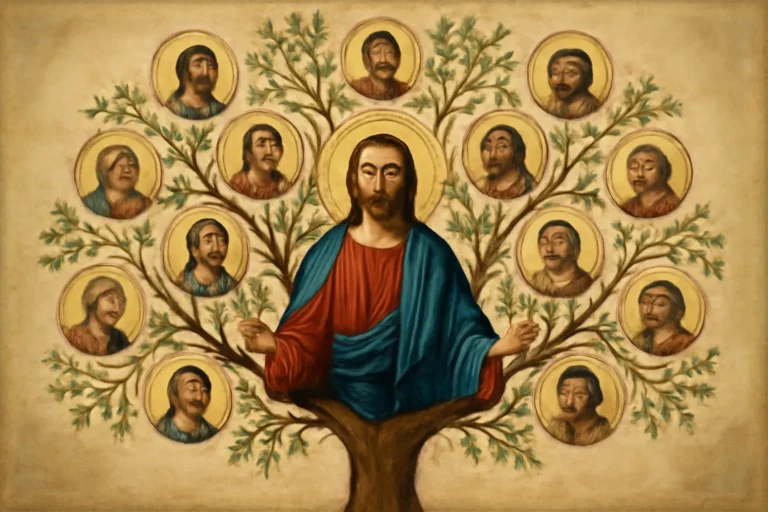
The story of Jesus is told, in the New Testament, through genealogical lines that reach back to the patriarchs and forward into
the earliest church era. This long-form examination, titled “The Family Tree of Jesus: A Genealogical Journey from Abraham to Mary”,
invites readers into a careful exploration of how ancient genealogies were constructed, what they signified in biblical theology,
and how the figure of Mary sits within this sacred lineage. While the canonical texts present two principal genealogies for
Jesus—one in the Gospel of Matthew and one in the Gospel of Luke—the overarching theme remains: a divine promise threaded
through generations, culminating in the Incarnation and the birth of the Messiah. In considering the Jesus family tree and
variations of it across biblical traditions, we encounter a vast landscape that blends history, faith, symbol, and worship.
This article does not merely enumerate names; it seeks to illuminate how genealogical writing functions within
biblical literature, how ancient readers would have interpreted lineage, and what the authority of such lists meant for early
Christians who sought to situate Jesus within the covenantal story of Israel. We will journey through phases of
salvation history—from the Abrahamic blessing to the Davidic throne to the exilic memory, and
finally toward the New Covenant fulfilled in Mary and Jesus. By examining the structure, the purposes, and the key figures in
these lineages, readers gain a richer, more nuanced understanding of how the family tree of the Messiah functions as a
theological sign, a liturgical refrain, and a pastoral invitation to trust in the divine plan.
Frameworks for Understanding Biblical Genealogies
Genealogies in the Bible perform more than a genealogical function; they are theological instruments that
identify Jesus with the promises God made to the patriarchs, while also creating a narrative bridge to the
audience’s memory—whether that audience is Jewish in the first-century world or a later reader seeking continuity with
the Christian story. In this section we consider several core frameworks that help readers interpret the family history of Christ.
- Covenantal identity: Genealogies often function as a register of covenantal descent. The promise God made to Abraham that in him all families of the earth would be blessed finds its audience in the Davidic covenant and the expectation of a lineage that bears responsibility for shepherding and blessing the nations.
- Messianic expectation: The dynastic line is used to demonstrate legitimacy for Jesus as the anointed one who would fulfill prophetic hope, rooted in the house of David and the unfolding drama of salvation history.
- Historical memory: Ancient readers cared deeply about ancestry because it connected present faith to a recognized past, enabling a sense of continuity with generations who lived under God’s unfolding plan.
- Literary design: The arrangement of generations—such as the triadic pattern in Matthew of three sets of fourteen—may encode symbolic meaning, numerical emphasis, and literary symmetry that assist memorization and liturgical reading.
In considering the genealogical record of Jesus, it is important to acknowledge that there are two canonical lines that
Christians often study side by side: the Matthewian lineage and the Lucan lineage. Each path contributes a different perspective
on the same Person and Purpose, and together they offer a more complete portrait of Jesus’ ancestral context.
Two canonical perspectives, one sacred intention
The Gospel of Matthew traces the Messiah’s line from Abraham to Jesus, emphasizing the legal right
to the throne through kingly ancestry. The Gospel of Luke, by contrast, traces a line that ultimately leads to Jesus
from Adam, highlighting the universal reach of the Incarnation and the humanity of Christ. Readers often
note that one genealogy emphasizes the royal lineage connected to David, while the other highlights the human family history
shared by all people. Both voices together deepen our sense of Jesus as the fulfillment of God’s redemptive plan for
Israel and for all nations.
Here, we will use the language of the Jesus family tree in a broad, inclusive way, speaking about
the ancestral map of Christ in ways that are faithful to the text and attentive to traditional interpretations. We will also
address some common questions about the place of Mary within this genealogical framework, and we will explore how the
Virgin Birth shapes the way the lineage is understood and proclaimed in Christian worship and doctrine.
From Abraham to David: The Promise-Bearing Line
The early portion of the genealogical narrative centers on the patriarchs and the emergence of the
people of the promise. In biblical theology, Abraham stands as the father of all who believe,
and the subsequent generations carry forward the vocation to be a blessing to all nations. The journey toward David
marks a pivotal moment in the narrative because the great king’s line represents a fulfillment of blessing, law, and kingship that
prefigures the Messiah.
Key figures and theological significance in this stretch
- Abraham: The patriarch whose faith is counted as righteousness, and whose blessing extends to all nations (Genesis 12–22).
- Isaac and Jacob: The continuations of the covenantal line, where divine promises mature under shifting conditions and relational dynamics.
- Judah and the royal line: The tribe of Judah becomes the vessel through which the Messiah is promised to come, culminating eventually in the kingship lineage.
- David: The archetype of the shepherd-king, whose dynasty is both a hope and a test for fidelity to God’s covenant. The expectation of a Messiah from the House of David is central to biblical prophecy.
- Solomon and subsequent kings: The histories of wisdom, temple, judgment, and the moral complexities of governance illustrate how lineage reflects divine calling and human frailty alike.
The narrative arc from Abraham to David is not merely a genealogical list; it is a doctrinal statement about selective blessing,
the formation of a theological community, and the preparation for a future in which God’s presence would be proclaimed to the nations through
a kingly line that perfectly embodies justice, mercy, and faithfulness.
In this phase we also encounter important typologies: the calling of Abraham’s family as a light to the world, the Davidic ideal of a ruler who rules
with justice and righteousness, and the role of prophets who call the people to fidelity. The convergence of these streams in the person of Jesus
becomes a focal point for Christian interpretation of the Messiah’s identity.
From David to the Exile: The Royal Decline and the Remnant
The middle portion of the genealogical record emphasizes the decline of the monarchy, the destruction of the temple, and the painful memory of exile.
These events are not merely historical footnotes; they shape the way the faithful understand the long arc of salvation history. Even in a period of decline,
God preserves a remnant and keeps alive the expectation of a future king who will restore the throne to its rightful dignity under divine sovereignty.
The prophetic lens on lineage
- Prophetic voices remind the people that external power is not the only measure of divine blessing; covenant faithfulness, justice, and mercy
remain at the heart of God’s plan. - The exile becomes a theological pivot: it reframes memory, identity, and hope, pointing toward a future restoration that hinges on fidelity to God.
- Messianic anticipation persists in the background, with the conviction that a future anointed king will bring peace, justice, and reconciliation.
In Matthew’s account, the exile experience is braided into the narrative to highlight a continuity of Davidic rule in exile and a
restoration that will be embodied in Jesus. In Luke’s account, the emphasis tends to shift toward a broader human family and the
universal scope of salvation, yet the longing for a rightful heir remains a constant thread. The genealogy as theology
thus becomes a bridge between national memory and cosmic purpose: a God who remains faithful to promises even across upheaval and time.
From Exile to Jesus: The Return, the Covenant, and the Incarnation
The return from exile and the subsequent centuries in Judea set the stage for the emergence of the New Covenant narrative. In biblical
theology, the lineage of Jesus is not merely a genealogical curiosity; it is a signal that the long-awaited fulfillment is at hand. The
genealogies in the Gospels of Matthew and Luke anchor Jesus’ identity in the history of Israel while pointing beyond it to the
universal significance of the Gospel.
In the Gospel of Matthew, the tracings from Abraham to Jesus emphasize the royal lineage and the permission to rule
in fidelity to God’s law. In Luke, the lineage is framed to underscore the humanity of Christ and the scope of the
salvation he embodies—extending not only to the Jews but to all peoples. In both, the end of the line points to a divine entry into
human history through the Virgin birth, and the role of Mary is pivotal in the mystery of the Incarnation.
The two genealogies, a unified proclamation
- Matthew’s pathway: Abraham → Isaac → Jacob → Judah → David → generations leading to Jesus; emphasizes legal and royal legitimacy.
- Luke’s pathway: Adam → Seth → Noah → Abraham → David → generations to Jesus; emphasizes universal humanity and the breadth of salvation.
- Mary’s place: The canonical texts do not explicitly present Mary in these genealogies; rather, the genealogies point to Jesus, and Mary’s role as the mother of the Incarnate Word is presented through the narratives surrounding Jesus’ birth and infancy.
The central theological claim is that Jesus is the fulfillment of God’s promises, a figure who embraces the divine purpose of
the people of God while also inaugurating a new era of grace. The genealogical signs help the Christian community see that the beginning of
the Gospel is not a sudden rupture from the past, but a purposeful fulfillment of what God has spoken through the ancestors, prophets, and
kings.
Mary in the Genealogical Conversation: Tradition and Theology
The question of whether Mary appears in the genealogical records is a longstanding topic in Christian interpretation. In
canonical scripture, the two primary genealogies are oriented toward Jesus, not Mary, and the lines typically run through
Joseph as the legal father. However, a number of theological and exegetical traditions have wrestled with Mary’s place within the
broader family history.
Mary and the concept of the Immaculate Conception and Virgin Birth
The event of the Virgin birth—through which Mary conceives Jesus by the power of the Holy Spirit—emerges as a climactic moment in
salvation history. The encodings of this event are not primarily genealogical; rather, they reveal a divine action that brings about
the Incarnation. Yet the Virgin birth is deeply connected to the lineage narrative in that Jesus is born into a line that begins with the
patriarchs, continues through David, and culminates in the Christ who is Immanuel, God with us.
Some scholars and traditions have observed that Luke’s genealogy, though presented as Joseph’s line, can be interpreted as a window into
Mary’s ancestry, given the close relationship between Mary and Jesus in the infancy narratives. This interpretive approach emphasizes the
theological possibility that Mary’s family line might participate in the fulfillment of the promises of Abraham and David in a way that
resonates with the notion of habitable grace within the human family.
Mary as the vessel of the Incarnation
The mother of Jesus is often portrayed in liturgy and devotion as the one who bears the Word made flesh in a manner that honors
both human reality and divine mystery. Theologically, Mary’s role is not merely peripheral but central to the drama of God’s
entry into the human story. The idea of the “holy lineage” surrounding Mary calls believers to recognize the sanctity of
human generation as a space for God’s transformative work.
In light of this, the phrase “Mary and the lineage of Christ” can be read as a holistic image: a lineage that extends
beyond masculine lines to include the nurture, fidelity, and witness of a mother whose faith echoes through the generations. The
integration of Mary into contemplations about the Jesus family tree invites a fuller understanding of salvation history as a story that
encompasses father, mother, and child within the divine drama of redemption.
The Names in the Family Tree: Key Figures and Their Theological Echoes
While a complete listing of every name in the genealogies would be vast, a focused sampling helps illuminate the doctrinal and spiritual
themes that flow through the family tree of Jesus. Below is a structured approach to identifying major figures and the roles they play in
the broader narrative.
- Abraham: The father of faith; his blessing becomes the vocation of the many nations.
- Isaac and Jacob: The carriers of covenantal continuity; their stories reveal the dynamics of trust and divine favor.
- Judah and the royal line: The tribe that bears the kingly promise forward toward David.
- David and the Davidic Covenant: The idealized king whose line points to the future ruler who will bring justice and peace.
- Solomon and subsequent monarchs: The realm’s complexities—wisdom, wealth, and sometimes faltering obedience to God’s laws.
- Prophets who shape the memory of the lineage: Their voices call the people to faithfulness and hope, even in exile.
- Exilic memory and post-exilic figures: The remnant identity, the longing for restoration, and the outward signs of faithfulness in a changed world.
- Jesus of Nazareth: The culmination of the lineage in whom all the strands of promise—blessing to the nations, ruler-king, and Emmanuel—find their center.
Each name in the genealogical record is a point of contact between history and faith. Readers are invited to consider not only the exact
lineages but also the broader implications: the ways in which generations model faith, obedience, and trust in a God who remains faithful to
the covenant. The family tree of Jesus is thus best understood as a living document—one that invites ongoing study,
devotion, and worship.
Practical and Educational Reflections: Reading the Genealogies
For students of the Bible, the genealogies of Jesus offer a compelling case study in how sacred texts convey meaning through
structure, naming, and narrative emphasis. Here are some practical reflections to guide personal study or classroom teaching.
- Recognize the purposes behind genealogies: covenantal identity, messianic expectation, and continuity with Israel’s history.
- Acknowledge literary design alongside historical data: the threefold fourteen pattern in Matthew is often discussed as a mnemonic and symbolic feature.
- Compare the two Gospel accounts to see how Matthew emphasizes royal descent while Luke emphasizes human solidarity and universal salvation.
- Distinguish lineage from nativity: the genealogical record provides lineage and legitimacy, while the nativity narratives reveal the mysteries of the Incarnation and Mary’s role in that mystery.
For educators, these insights can be translated into engaging lessons that invite students to explore how faith communities interpret
their origins, how God’s promises unfold over time, and how the faithful respond to revelation in various historical moments. For
lay readers, the genealogies offer a theological invitation to contemplate one’s own spiritual ancestry—how grace and faith travel
through generations to shape present fidelity and future hope.
Summary: The Family Tree as a Map of Salvation History
In sum, the genealogical journey from Abraham to Mary through Jesus unfolds as a pilgrimage through salvation history. It
is a map that points to the fulfillment of God’s promises, the emergence of the Messiah, and the dawning of a new era in which the
love of God is poured out to all nations. The Mary-centered horizon of this narrative invites believers to reflect on
the mystery of the Incarnation, the dignity of human lineage, and the possibilities of grace that transform ordinary genealogies into
sacred histories.
For those who study biblical genealogies with reverence, the Jesus family tree offers a wealth of insights. It is not a mere
list of names; it is a theological tapestry—woven with threads of faith, memory, covenant, and hope. It invites readers to see how God has
worked through families, tribes, and nations to accomplish the salvation of the world. It also invites a humble sense of the present: to
trust that the divine plan continues in an ongoing, living way through the church, through believers, and through the witness of Mary’s
foreshadowing of faithfulness.
Ultimately, the genealogical journey from Abraham to Mary centers on a single reality: God’s faithfulness to
the promises that formed Israel and that reach out in Jesus to encompass all humanity. When readers grasp this continuity, they discover
not only a historical sequence but a sacred drama in which every generation has a place and a purpose in God’s salvation plan.