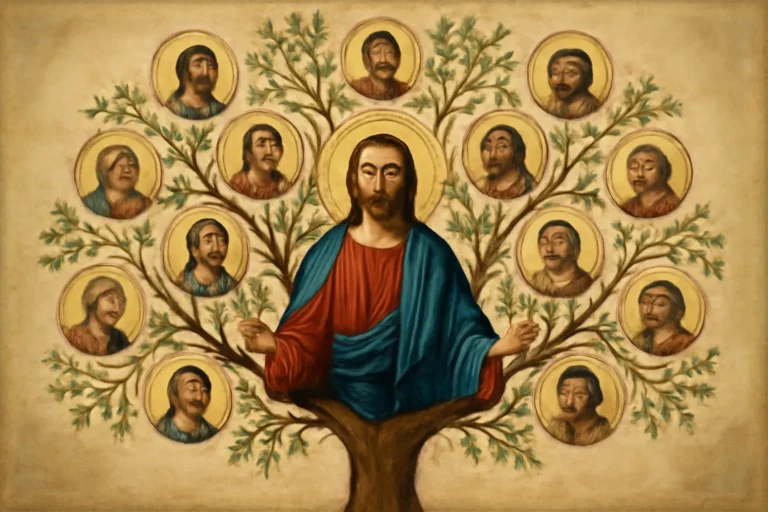

Overview: The Matthean Genealogy and Its Significance
The Matthean genealogy – the opening framework of the Gospel according to Matthew – stands as one of the most discussed and studied passages in the New Testament. This ancestral record serves not merely to catalogue names, but to curate a theological narrative: a bridge from the patriarchs of Israel to the Messiah, from the promise to its fulfillment in the person of Jesus. In this article we explore the genealogy of Jesus in Matthew as a literary, theological, and devotional device, analyzing its structure, its rhetorical aims, its intertexts with Jewish Scripture, and its implications for Christian faith and practice. We will also consider how the Matthean lineage compares with Luke’s account, why four women appear in the list, and what the closing words of the chapter imply for readers’ understanding of Jesus’s place in salvation history.
Literary and Theological Context: Where the Genealogy Fits in Matthew
First, the Matthean Gospel opens with a distinct purpose: to present Jesus as the Christ, the fulfillment of God’s promises to Israel. The genealogy functions as the overture to this claim. It is not a neutral roll call; it is a crafted introduction that situates Jesus within a long arc of redemptive history. Several features mark this passage as distinctly Matthean in character:
- Patriarchal linkage: The line runs from Abraham to Jesus, underscoring Jesus’s inclusion in the covenant households of Israel.
- Davidic emphasis: The title son of David appears early in the proclamation of Jesus, highlighting the Messiah’s expected dynasty and rightful heirship.
- Triadic numerology: The periodization into three sets of fourteen generations (with some textual debate about the exact counting) suggests poetic design and theological symbolism rather than mere chronology.
- Intertextual resonance: The Matthean list cues readers to prophetic fulfillment and to the broader biblical narrative in which Jesus stands as the one who fulfills what God spoke through the prophets.
Second, the list foregrounds the notion of fulfillment as a central interpretive key. In Matthew 1:22–23, the evangelist writes that “all this took place to fulfill what the Lord had spoken by the prophet”, which frames the entire genealogy as a bridge between Old Testament expectation and New Testament realization. The fulfillment motif is thus a theological hinge: the genealogical record is not just about lineage; it is about God’s faithful fulfillment of covenantal promises through the birth of Jesus, the one who bears the Messianic vocation for Israel and, for Matthew, for the nations as well.
The Form and Function: What a Genealogy Does in a Gospel Narrative
To understand the genealogy of Jesus in Matthew, one needs to read it both as a literary device and as a theological claim. A genealogy in the Hebrew and Mediterranean world often frames a story, legitimizes a ruler, or marks a turning point in salvation history. Matthew’s version accomplishes all of these ends in a uniquely Christian key. Consider several functional aspects:
- Narrative legitimization: The list grounds Jesus’s authority in a historical and familial continuum that is recognizably linked to Israel’s founding figures and to the Davidic monarchy.
- Theological messaging: The inclusion of certain women and the naming of the royal line collectively signal God’s redemptive plan that embeds unconventional and even provocative elements (see the women’s inclusion below).
- Pastoral and liturgical function: The genealogy invites early Christian and later readers to meditate on God’s faithfulness across generations, offering a model for how faith communities remember, recite, and reinhabit their own story in light of Christ.
- Christological reframing: Jesus is presented not only as a child of David but as the culmination of Israel’s story, through whom the promises extend to all peoples.
Structure of the Matthean List: Three Sets of Fourteen Generations
A celebrated aspect of Matthew’s genealogy is the triplet division into three sets of fourteen generations. This triad has sparked extensive scholarly discussion. Some see it as a deliberate numerological pattern (14 = David’s name value in Hebrew gematria), while others view it as a symbolic structuring device to aid memory and to link the generations in meaningful groupings. Regardless of the theory one favors, the structure communicates intentional design and invites deeper engagement with the narrative arc of the list.
Understanding the Threefold Pattern
Here is a concise outline of the conceptual threefold structure, not a verbatim counting of every name, but a map of how the generations unfold:
- First sequence – from Abraham to David. This establishes Jesus’s entry into the promise-soaked line of the patriarchs and the monarchy, anchoring the Gospel in the founding narratives of Israel.
- Second sequence – from David to the exile in Babylon. This segment traces the kingly line’s continuity through the Solomonic and post–Solomonic generations, culminating in the exile that marks a major rupture in Israel’s history.
- Third sequence – from the exile to Christ. The concluding set reconstitutes the line as it leads toward the birth of Jesus, with the fulfillment of prophecy and the inauguration of a new era in salvation history.
In addition to this structural feature, the list includes a number of notable inclusions and textual nuances that have stimulated interpretive discussion, as we turn to the next section.
Women in the Genealogy: Four Foregrounded Figures
One of the most striking and debated aspects of Matthew’s Matthean genealogy is the inclusion of four women, a departure from many ancient genealogical conventions. In the list, we encounter Tamar, Rahab, Ruth, and Bathsheba (referred to as “the wife of Uriah”). This is not merely a curious detail; it is a deliberate theological and literary choice with rich implications:
- Tamar in the line of Judah signals the theme of complex family dynamics and the way God can work through imperfect situations to bring about the continuity of the line.
- Rahab, a Gentile and a Canaanite, embodies the inclusion of non-Israelites into the faith community and, in Matthew’s broader narrative, foreshadows the eventual to-the-nations mission of the church.
- Ruth, another Gentile (Moabite) who becomes part of the people of Israel, likewise foregrounds the widening reach of God’s salvation beyond ethnic boundaries.
- Bathsheba (the wife of Uriah) is named subtly, drawing attention to David’s sin and the grace that mediates through lineage. The designation “wife of Uriah” elides the king’s act of adultery and focuses readers on the legitimacy of the royal line despite human flaws.
These female entries invite readers to see the Matthean genealogy as a narrative that anticipates the gospel’s broader inclusion of Gentiles and the remodeling of Israel’s identity in light of Jesus. The women’s presence also resonates with Luke’s genealogy, which includes different female figures and emphasizes the universality of the Messiah’s reach, though Matthew’s emphasis remains deeply rooted in the Davidic and Abrahamic covenants.
The Matthean Formula: Fulfillment and Covenant Continuity
A crucial interpretive key for reading the genealogy of Jesus in Matthew is the repeated formula that signals fulfillment. In the opening chapter, the evangelist situates Jesus within God’s redemptive plan by connecting his life to prophecy and to the promises made to the ancestors. Several notable features emerge:
- Prophetic fulfillment: The quotation in 1:22–23 explicitly ties the events surrounding Jesus’s birth to the Old Testament prophecy about a virgin conceiving and bearing a son named Immanuel. This is a central Johannine and Matthean motif, asserting Jesus as the fulfillment of God’s word.
- Covenantal continuity: By tracing Jesus’s lineage back to Abraham and David, Matthew emphasizes that the Messiah belongs to the core promises given to Israel, underscoring the continuity between the old covenant and the new creation inaugurated by Christ.
- Legal-religious legitimacy: The genealogical linkage through Joseph – the husband of Mary – provides Jesus with a legal right to the throne of David, even as he is born of a virgin. This dual legitimation—legal and divine—underwrites the Christian claim about Jesus’s identity and mission.
For readers and worshippers, the Matthean framework offers a profound invitation: to read Jesus’s life as the culmination of years of waiting, preparation, and faithful obedience within the people of God. The genealogical record becomes a catechetical tool for remembering the promises and discerning how Jesus embodies their fulfillment in a surprising, inclusive, and transformative way.
Textual Nuances and Variants: Matthew’s Unique Emphases
Scholars often contrast Matthew’s genealogy with Luke’s. While Luke’s genealogy traces a line from Jesus backward to Adam and emphasizes the universal reach of the gospel, Matthew’s focus is more tightly tied to Israel’s redemptive history and the Davidic expectation. Some key contrasts and features include:
- Order and scope: Matthew’s list proceeds from Abraham to Jesus, with David at pivotal junctions, whereas Luke compiles a descent that places David early but extends toward Adam.
- Inclusion of women: Matthew’s inclusion of four women is distinctive and often read as a deliberate theological signal about Gentile inclusion and the moral complexity of biblical narratives.
- Name choices: The names are largely drawn from traditional Israelite lists, yet the presence of non-Israelite figures (in the sense of their non-Israelite origins) in the women’s stories highlights a broader salvific horizon than might be expected in a strictly “patriarchal” genealogy.
- The presence of Jeconiah (also called Jehoiachin) and the exile anchors the list in a historical moment of crisis, suggesting that the Messiah enters a history that has seen judgment, exile, and hope alike.
These textured features contribute to a robust interpretive field: for some readers, the Matthean genealogy is a blueprint for the way God’s purposes unfold across generations; for others, it is a model of how the church reads the past as a living invitation to participate in God’s unfolding plan through Christ.
Appendix: The Full Matthean Genealogy (Representative Rendering)
For readers who wish to engage directly with the sequence of generations, here is a representative rendering of the Matthean genealogy, reflecting the traditional order and the threefold structure. This is intended as a functional guide to the names and their positions within the tripartite design. The list begins with Abraham and ends with Jesus, as Matthew presents the sequence in 1:2–16, with the concluding summary in 1:17.
- Abraham
- Isaac
- Jacob
- Judah
- Perez
- Hezron
- Ram
- Amminadab
- Nahshon
- Salmon
- Boaz
- Obed
- Jesse
- David
- David
- Solomon
- Rehoboam
- Abijah
- Jehoshaphat
- Joram
- Uzziah
- Jotham
- Ahaz
- Hezekiah
- Manasseh
- Amon
- Josiah
- Jeconiah
- Shealtiel
- Zerubbabel
- Abiud
- Eliakim
- Azor
- Zadok
- Akim
- Eliud
- Eleazar
- Matthan
- Jacob
- Joseph
- Jesus
Note: The full text in Matthew 1:2–16 includes the genealogical formula and the statement that “Jacob begat Joseph, the husband of Mary, of whom was born Jesus”, which completes the triad of generations and introduces Jesus as the Messiah. The reader should approach this list with sensitivity to its liturgical function and its theological aims, rather than reading it as a modern historical roll call alone.
From Genesis to the Gospels: The Matthean Genealogy in Salvation History
To situate the genealogy of Jesus in Matthew within the broader biblical narrative, it is helpful to trace the way the list mirrors and reframes canonical expectations. The Genesis narratives begin with a phrase about generations, and the Hebrew Bible contains several generations lists that orient readers to the movement of God’s people through time. Matthew’s list consciously taps into this biblical vernacular: it speaks of generations to connect the birth of Jesus with God’s long arc of redemption. Several theological motifs emerge when reading Matthew’s genealogical opening in dialogue with the Old Testament:
- Covenant fidelity: God’s promises to Abraham and David are not relics of ancient memory; they are living commitments that find their fulfillment in Jesus.
- Hope amid exile: The presence of the exile in the middle of the threefold sequence serves to remind readers that even difficult chapters of history are not the end of the story; they are the space in which God’s salvation continues to unfold.
- Missional horizon: The inclusion of Gentile-associated figures in the line foreshadows the gospel’s mission to the nations, a theme that becomes explicit in Matthew’s narrative after the birth of Jesus with the Great Commission and the missionary activity of the church.
Thus, the Matthean genealogy is not simply a catalog of names. It is a theological compact: a compact that invites contemplation on how God’s faithfulness operates across generations, how the Messiah enters human history, and how the church is summoned to participate in the ongoing story of salvation.
Practical and Theological Implications for Readers and Worshippers
How might contemporary readers engage with the genealogy of Jesus in Matthew in a way that informs faith and life? Several practical implications emerge from this historical-theological reflection:
- Identity formation: Recognizing Jesus as a descendant of Abraham and David can ground Christian identity in the long history of God’s people, while also inviting believers to see themselves as part of God’s ongoing covenantal purposes.
- Hospitality to the outsider: The inclusion of women who were Gentile or linked to difficult narratives invites a posture of openness and welcome toward those who are outside the conventional boundaries of faith communities.
- Hope amid adversity: The exile motif reminds readers that even times of disruption can become spaces where God works to realign history toward the coming of Christ.
- Liturgical memory: Reciting or meditating on the genealogical list can function as a form of liturgical memory, training the heart to recognize the pattern of promise-fulfillment across generations.
In catechesis, homiletics, and personal devotion, the Matthean lineage can be used as a framework for exploring topics such as covenant, kingship, virtue and vice among biblical figures, and the miraculous manner in which God acts to bring about salvation for all nations.
Frequently Asked Questions about Matthew’s Genealogy
To conclude, here are concise responses to common questions that arise around the Matthean genealogical record:
- Why does Matthew include four women? The women in the Matthean genealogy (Tamar, Rahab, Ruth, Bathsheba) function as theological signals of God’s grace and the widening scope of salvation beyond a narrow patriarchal line. They draw attention to themes of faith, risk, and inclusion and invite readers to reflect on how God works through surprising people and circumstances.
- Is the genealogy historical? Many scholars treat Matthew’s list as a theological-interpretive genealogy that uses selective and symbolic structuring to communicate the identity and mission of Jesus. While it draws upon historical memory, its primary aim is rhetorical and theological: to present Jesus as the rightful heir and the fulfillment of the Covenant.
- What is the significance of the exile in the third generation? The exile serves as a turning point in Israel’s history. By placing the exile in the center of the threefold pattern, Matthew highlights that the Messiah enters a history marked by judgment and hope and that God’s purposes persist through crisis toward restoration in Christ.
- How does the Matthean genealogy relate to Luke’s genealogy? Matthew emphasizes Abraham and David and the royal line in order to anchor Jesus’s messianic identity, whereas Luke emphasizes universal humanity (going back to Adam) and emphasizes Jesus as the Savior of all people. Both navigations offer complementary strands for understanding the salvation history the New Testament proclaims.
Conclusion: The Genealogy as a Lens on Faith
The genealogy of Jesus in Matthew is a masterful convergence of narrative artistry, covenant memory, and theological drama. It invites readers to see Jesus not as a break with Israel’s story but as its culmination and expansion. The Matthean ancestral roll locates Jesus in a history of promise and travail, yet it also opens the door to a new era in which Gentiles and Jews alike are drawn into God’s salvific mission. Through its triadic organization, its inclusion of four remarkable women, and its insistence on fulfillment, the Matthean genealogy reveals a God who is faithful across generations and who invites every generation to faithful participation in the drama of salvation.
For further study, consider reading Matthew 1 closely with cross-references to Isaiah’s prophecies, Genesis’s genealogies, and Psalms that illuminate the kingly and messianic expectations. Reflect on how the threefold structure shapes the reader’s sense of time, history, and destiny in Christ. Explore how the five key terms introduced here—covenant, fulfillment, Messiah, Davidic line, and Gentile inclusion—interact to form the core of Matthew’s opening movement and set the stage for the gospel’s subsequent narrative arc.